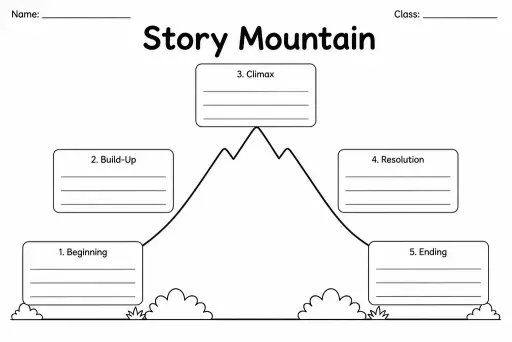
Story Mountain
Graphic Organizers
Ages 4–11
——
KiwiBee uses optional Google Analytics, Google Ads, and Meta Pixel cookies to understand adult visitors, measure completed sign-ups, and improve campaigns. Essential cookies always stay on. OpenAI’s ChatGPT Ads Pixel also measures page views and completed enquiries after advertising consent, and may use hashed contact details for matching. Privacy policy

The Setting Description Organiser is a blank senses-based graphic organizer with a dedicated zone for each of the five senses — see, hear, smell, taste, touch — plus an optional feelings or mood section. Students record sensory details about a story setting, a visited location, a science environment, or an imagined scene, giving them a rich bank of details to draw on when writing descriptive prose. Designed for Grades 2 through 6, this template bridges reading and writing. Teachers assign it after shared reading to help students identify how an author builds setting through sensory language. Students also use it as a pre-writing planning tool before drafting a descriptive paragraph or narrative opening. Because the blank zones impose no content, the same printable works for describing an Antarctic tundra in a geography lesson, the atmosphere of a historical marketplace, or the setting of a novel a student has self-selected for independent reading.
Students can write 'no taste details given' or use the zone to imagine what a character might taste in that environment. Noticing an absent sense is itself a thinking skill — it helps students identify gaps they can fill as writers.
Absolutely. It is a strong tool for field science journals, geography fieldwork, art gallery visits, and any activity where close observation is the goal. The senses framework works independently of any text.
A story map captures the overall narrative structure — characters, problem, events, resolution — and includes setting as one element among many. The Setting Description Organiser dedicates all its space to one setting, exploring it in much greater sensory depth.
Grade 2 students handle it well, especially after the teacher models one or two zones on a shared read-aloud. You can simplify by starting with just see, hear, and touch before introducing smell, taste, and mood for younger learners.
See what other teachers think and share a helpful note.
Generate a fresh worksheet for any grade, topic and language. Free.
 Home
Home All solutions
 Pricing
 About us
 KiwiBee for Non-profits
 Events & webinars
 For big organisations
 For schools
 For centers
 For team leaders
 For teachers
 AI and resources
 Resources
 Printable worksheets
 Lesson Packs
 Interactive simulations
 Teacher tools
 AI studio
 Ideas and research