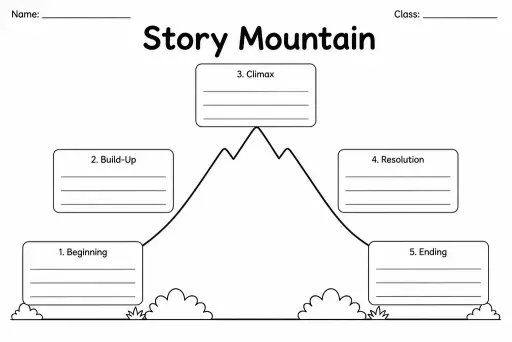
Story Mountain
Graphic Organizers
Ages 4–11
——
KiwiBee uses optional Google Analytics, Google Ads, and Meta Pixel cookies to understand adult visitors, measure completed sign-ups, and improve campaigns. Essential cookies always stay on. OpenAI’s ChatGPT Ads Pixel also measures page views and completed enquiries after advertising consent, and may use hashed contact details for matching. Privacy policy

The Sequence Chart (First-Next-Then-Last) gives early learners four ordered blank boxes, each labeled with a transition word, to map out events in the order they happened. Kindergarten through grade 4 students use it to retell stories, explain procedures, and document science observations step by step. Teachers in primary grades rely on it during shared writing and guided reading to build the concept of narrative and procedural order. Parents can use it at home after reading a picture book to help a child practice retelling before bed. The four-part structure mirrors the natural language children already use—"First we mixed, then we poured"—making the jump from thinking to writing feel small and achievable. Because the boxes are completely blank, the same sheet works for a fairy-tale retell on Monday and a cookie-baking how-to on Friday.
Yes. Students can draw pictures in each box rather than writing words. The teacher or a partner can scribe the transition words below each drawing during a guided activity.
Students choose the four most important events. This is a valuable comprehension skill in itself—deciding what is essential enough to include in a four-step summary.
It overlaps, but the focus here is purely on order and transition words rather than on character, setting, or theme. The Sequence Chart is ideal for procedural texts and step-by-step science observations as well as narrative retelling.
Laminate a class set and students write with dry-erase markers. Alternatively, slide the printed chart into a plastic sleeve for the same reusable effect.
See what other teachers think and share a helpful note.
Generate a fresh worksheet for any grade, topic and language. Free.
 Home
Home All solutions
 Pricing
 About us
 KiwiBee for Non-profits
 Events & webinars
 For big organisations
 For schools
 For centers
 For team leaders
 For teachers
 AI and resources
 Resources
 Printable worksheets
 Lesson Packs
 Interactive simulations
 Teacher tools
 AI studio
 Ideas and research