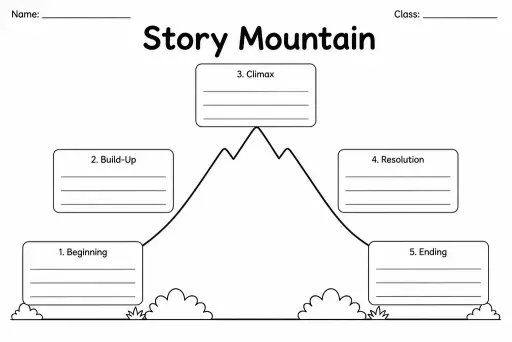
Story Mountain
Graphic Organizers
Ages 4–11
——
KiwiBee uses optional Google Analytics, Google Ads, and Meta Pixel cookies to understand adult visitors, measure completed sign-ups, and improve campaigns. Essential cookies always stay on. OpenAI’s ChatGPT Ads Pixel also measures page views and completed enquiries after advertising consent, and may use hashed contact details for matching. Privacy policy

A blank reading bingo board is an empty 5×5 grid that teachers, parents, or students fill with their own reading challenges before play begins. Each square becomes a task—read a book with a blue cover, finish a biography, read outside for 20 minutes, recommend a title to a friend—turning a reading period into an engaging, low-pressure game. The FREE center square is already marked, giving everyone an instant head start. Because the squares are blank, the board adapts to any grade from kindergarten through 8th grade and any reading focus. Teachers print a class set, write challenges together as a morning activity, then have students color or stamp squares as they complete each one. Parents use it to add variety to summer reading. A single template sheet serves an entire reading unit or the whole school year.
Mix genre prompts (read a mystery), setting prompts (read outside), social prompts (recommend a book to a friend), and length prompts (read a book in one sitting) to keep the board varied and achievable.
Most teachers run a board over 4–8 weeks, but it can span a full semester. Set a clear end date so students pace themselves and stay motivated.
Both work. Teacher-filled boards ensure curriculum alignment; student-filled boards increase ownership. A hybrid approach—teacher fills half, students choose the other half—works especially well.
Ask students to keep a brief note or drawing for each completed square—a sentence about what they read, a sketched cover, or a sticky note title—as light evidence without heavy assessment.
See what other teachers think and share a helpful note.
Generate a fresh worksheet for any grade, topic and language. Free.
 Home
Home All solutions
 Pricing
 About us
 KiwiBee for Non-profits
 Events & webinars
 For big organisations
 For schools
 For centers
 For team leaders
 For teachers
 AI and resources
 Resources
 Printable worksheets
 Lesson Packs
 Interactive simulations
 Teacher tools
 AI studio
 Ideas and research