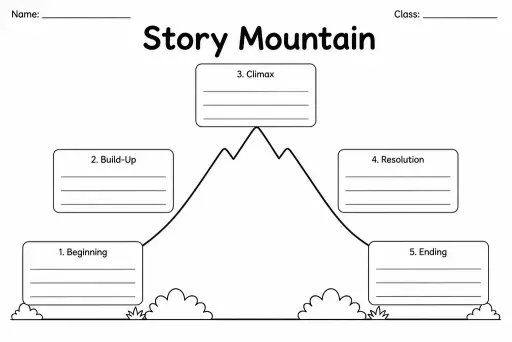
Story Mountain
Graphic Organizers
Ages 4–11
——
KiwiBee uses optional Google Analytics, Google Ads, and Meta Pixel cookies to understand adult visitors, measure completed sign-ups, and improve campaigns. Essential cookies always stay on. OpenAI’s ChatGPT Ads Pixel also measures page views and completed enquiries after advertising consent, and may use hashed contact details for matching. Privacy policy

The Pros and Cons / For and Against template presents a clean two-column chart with a header row for the topic or question, a bold dividing line down the centre, and equal-height ruled rows on each side for listing positives and negatives. Designed for Grades 3–8, it gives students a visible, balanced structure for evaluating decisions, forming arguments, analysing historical choices, or weighing up competing scientific approaches. Teachers reach for this template in debate preparation, persuasive writing units, and critical-thinking discussions. It encourages students to consider both sides before committing to a position — a habit that strengthens argumentative writing and civil discourse skills. Because the layout is completely blank, it adapts to any curriculum area: should this character have made that choice, should we ban plastic straws, should homework be abolished — any two-sided question fits.
The standard template provides eight ruled rows per column — enough for a thorough analysis of most topics while keeping the task manageable for a single lesson.
Yes. For Grade 3, teachers often limit the task to three items per column and allow drawings alongside words. The visual split of the two columns helps young learners grasp the concept of two opposing sides.
Both labels are included on the template — you choose which heading to display based on your lesson context. Pros and Cons suits decision-making and analytical tasks; For and Against suits debate preparation and persuasive writing.
Absolutely. Parents use it with children when making choices like which after-school activity to join or how to spend birthday money. Practising structured decision-making at home reinforces the same skills used in the classroom.
See what other teachers think and share a helpful note.
Generate a fresh worksheet for any grade, topic and language. Free.
 Home
Home All solutions
 Pricing
 About us
 KiwiBee for Non-profits
 Events & webinars
 For big organisations
 For schools
 For centers
 For team leaders
 For teachers
 AI and resources
 Resources
 Printable worksheets
 Lesson Packs
 Interactive simulations
 Teacher tools
 AI studio
 Ideas and research