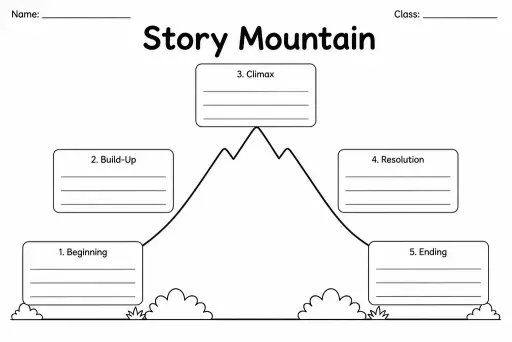
Story Mountain
Graphic Organizers
Ages 4–11
——
KiwiBee uses optional Google Analytics, Google Ads, and Meta Pixel cookies to understand adult visitors, measure completed sign-ups, and improve campaigns. Essential cookies always stay on. OpenAI’s ChatGPT Ads Pixel also measures page views and completed enquiries after advertising consent, and may use hashed contact details for matching. Privacy policy

The Problem and Solution Frame provides three clearly labeled blank boxes—Problem, Attempts, and Solution—laid out in a logical top-to-bottom sequence so students can map out how a challenge is identified, what is tried, and how it is resolved. Grades 2–7 use it to analyze story structure, break down real-world challenges, and plan persuasive or expository writing. Teachers reach for it during guided reading to help students see narrative structure, and again in writing workshop to help students draft a well-organized opinion or informational piece. The inclusion of an Attempts box distinguishes this frame from simpler two-part organizers—it captures the process of working through a problem, which mirrors both story development and real problem-solving. Parents find it useful when helping a child outline a science fair project or unpack the plot of a chapter book.
Students can list more than one option in the Solution box and then circle or star the one they consider most effective. This works especially well for opinion writing prep where students must defend a position.
Yes. Many informational texts—news articles, science reports, social studies readings—are organized around a problem-solution structure. Students fill in the frame as they read to track the argument or explanation.
For simple story problems, the Attempts box may have limited content, but it should still be used. Acknowledging what was tried—even if it failed—builds a more complete understanding of the text or issue.
Many state writing assessments include problem-solution prompts. Practicing with this frame helps students internalize the structure so they can produce organized responses quickly under time constraints.
See what other teachers think and share a helpful note.
Generate a fresh worksheet for any grade, topic and language. Free.
 Home
Home All solutions
 Pricing
 About us
 KiwiBee for Non-profits
 Events & webinars
 For big organisations
 For schools
 For centers
 For team leaders
 For teachers
 AI and resources
 Resources
 Printable worksheets
 Lesson Packs
 Interactive simulations
 Teacher tools
 AI studio
 Ideas and research