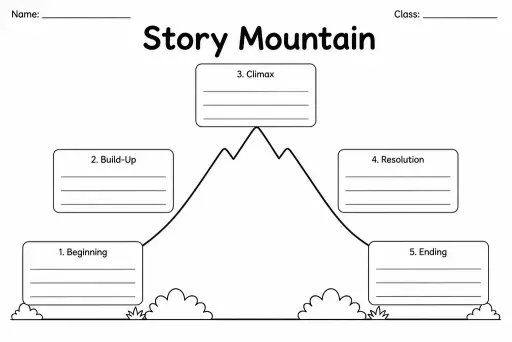
Story Mountain
Graphic Organizers
Ages 4–11
——
KiwiBee uses optional Google Analytics, Google Ads, and Meta Pixel cookies to understand adult visitors, measure completed sign-ups, and improve campaigns. Essential cookies always stay on. OpenAI’s ChatGPT Ads Pixel also measures page views and completed enquiries after advertising consent, and may use hashed contact details for matching. Privacy policy

A plot diagram is a blank graphic organizer shaped like a narrative arc — a triangle or mountain curve — that maps the five structural stages of a story: Exposition, Rising Action, Climax, Falling Action, and Resolution. Students label and annotate each stage as they analyze how a plot builds and releases tension, making story structure tangible and visual. Used in grades 4–8, the template bridges reading comprehension and literary analysis. English language arts teachers assign it after reading short stories, novels, or plays to reinforce Freytag's pyramid vocabulary. It also works as a pre-writing scaffold: students sketch their own plot arc before drafting a piece of creative fiction, ensuring their story has deliberate pacing and a satisfying resolution rather than trailing off without purpose.
Grades 4–8 is the target range. Fourth graders benefit from teacher modeling and guided completion; by grade 6, most students can complete the arc independently for novels and short stories.
Both map narrative arc, but the plot diagram uses Freytag's five formal literary terms (Exposition, Rising Action, Climax, Falling Action, Resolution) and is angled toward literary analysis. The story mountain uses student-friendly language and a visual mountain shape suited to earlier grades.
Yes — narrative non-fiction (memoirs, true-adventure accounts) follows a similar arc. Label Exposition as the background context and Climax as the decisive moment. Some stages may be shorter or less defined than in fiction.
Three to five events is a practical range. More than five can clutter the slope; fewer than three may mean students aren't tracking the full build of tension. Quality of annotation matters more than quantity.
See what other teachers think and share a helpful note.
Generate a fresh worksheet for any grade, topic and language. Free.
 Home
Home All solutions
 Pricing
 About us
 KiwiBee for Non-profits
 Events & webinars
 For big organisations
 For schools
 For centers
 For team leaders
 For teachers
 AI and resources
 Resources
 Printable worksheets
 Lesson Packs
 Interactive simulations
 Teacher tools
 AI studio
 Ideas and research