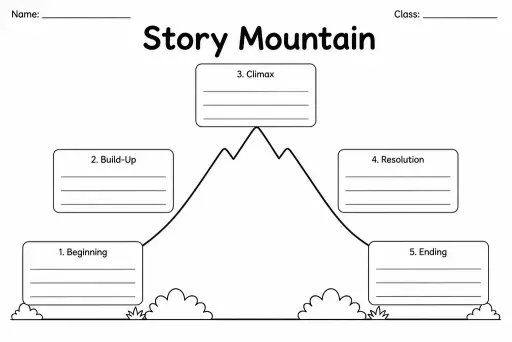
Story Mountain
Graphic Organizers
Ages 4–11
——
KiwiBee uses optional Google Analytics, Google Ads, and Meta Pixel cookies to understand adult visitors, measure completed sign-ups, and improve campaigns. Essential cookies always stay on. OpenAI’s ChatGPT Ads Pixel also measures page views and completed enquiries after advertising consent, and may use hashed contact details for matching. Privacy policy

The Persuasive Planner (OREO) is a blank graphic organizer structured around the OREO writing framework: Opinion, Reasons, Evidence/Examples, and restated Opinion. Each of the four layers has a clearly labeled blank zone, giving students a visual scaffold that mirrors the paragraph structure they need to produce in their final piece. Built for Grades 3 through 7, this template is a favourite among teachers introducing persuasive and opinion writing because the cookie-layer metaphor makes abstract essay structure tangible and memorable. Students use it to plan persuasive letters, class debates, opinion paragraphs, and five-paragraph essays by drafting each component before committing to a full draft. The blank nature of the template means it works for any topic — classroom rules, book recommendations, social issues, or history arguments — without requiring a new printable for each unit.
Two to three reasons work best for Grades 3 and 4. Grades 5 through 7 can aim for three reasons, each with at least one piece of evidence, which maps directly onto a standard five-paragraph persuasive essay structure.
They are closely related but not identical. PEEL (Point, Evidence, Explain, Link) and TEEL (Topic sentence, Evidence, Explain, Link) focus on a single body paragraph. OREO spans the full piece — from opening opinion through to concluding restatement — making it better suited for whole-text planning.
Yes. Each R in the Reasons zone can represent one full body paragraph, with the corresponding E zone used to note the evidence for that paragraph. Students then expand each zone into a full paragraph during drafting.
Concrete, low-stakes topics work best for first attempts — school lunch menus, the best season, whether a pet should be allowed in class. These familiar topics let students focus on the structure rather than the research, building confidence before moving to content-heavy argument tasks.
See what other teachers think and share a helpful note.
Generate a fresh worksheet for any grade, topic and language. Free.
 Home
Home All solutions
 Pricing
 About us
 KiwiBee for Non-profits
 Events & webinars
 For big organisations
 For schools
 For centers
 For team leaders
 For teachers
 AI and resources
 Resources
 Printable worksheets
 Lesson Packs
 Interactive simulations
 Teacher tools
 AI studio
 Ideas and research