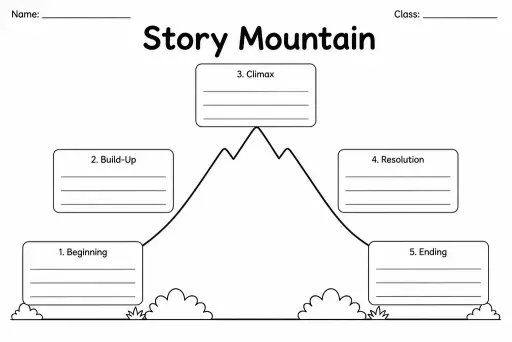
Story Mountain
Graphic Organizers
Ages 4–11
——
KiwiBee uses optional Google Analytics, Google Ads, and Meta Pixel cookies to understand adult visitors, measure completed sign-ups, and improve campaigns. Essential cookies always stay on. OpenAI’s ChatGPT Ads Pixel also measures page views and completed enquiries after advertising consent, and may use hashed contact details for matching. Privacy policy

The PEE / PEEL Paragraph Organiser is a blank graphic-organizer template that guides students through the Point-Evidence-Explain-(Link) paragraph writing framework. Each box on the page is clearly labelled with its role in the argument or analytical paragraph, giving writers an instant scaffold to follow before transferring ideas to a final draft. Suitable for English, humanities, and science report writing, this template is widely used in grades 5–8 whenever students need to move from bullet-point thinking to fully structured written responses. Teachers hand it out before essay drafts, literature responses, or persuasive tasks. Students work independently or in pairs to slot ideas into each section, ensuring no step in the reasoning chain is skipped. Because it is completely blank, the same sheet works for every topic and unit across the year.
PEE stands for Point-Evidence-Explain and produces a self-contained paragraph. PEEL adds a Link step at the end, which either ties back to the essay question or leads into the next paragraph — useful for multi-paragraph extended writing.
Yes. History, geography, science, and religious education teachers regularly use PEE/PEEL for analytical writing. The blank boxes work for any topic where students need to support a claim with evidence.
Absolutely. The PDF can be opened in any annotation app (Notability, GoodNotes, Google Drive) and filled in with a stylus or keyboard, making it fully compatible with 1-to-1 device classrooms.
One sheet covers one paragraph. For a full essay, print or duplicate the sheet for each body paragraph needed — typically three to five for a standard extended response.
See what other teachers think and share a helpful note.
Generate a fresh worksheet for any grade, topic and language. Free.
 Home
Home All solutions
 Pricing
 About us
 KiwiBee for Non-profits
 Events & webinars
 For big organisations
 For schools
 For centers
 For team leaders
 For teachers
 AI and resources
 Resources
 Printable worksheets
 Lesson Packs
 Interactive simulations
 Teacher tools
 AI studio
 Ideas and research