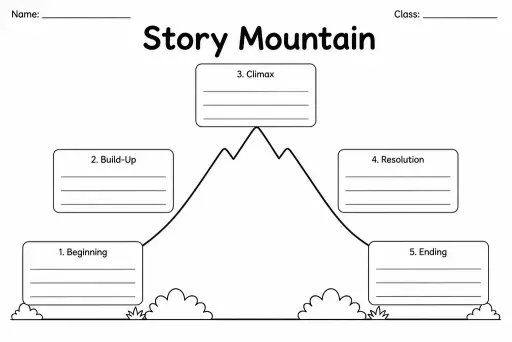
Story Mountain
Graphic Organizers
Ages 4–11
——
KiwiBee uses optional Google Analytics, Google Ads, and Meta Pixel cookies to understand adult visitors, measure completed sign-ups, and improve campaigns. Essential cookies always stay on. OpenAI’s ChatGPT Ads Pixel also measures page views and completed enquiries after advertising consent, and may use hashed contact details for matching. Privacy policy

The Newspaper Article Template gives students an authentic editorial layout to write inside: a masthead banner at the top for the publication name, a bold headline field below it, a rectangular image box with a caption line for a hand-drawn or pasted illustration, and two parallel ruled columns of text that replicate the classic broadsheet format. This structure teaches students in grades 3 through 8 the conventions of journalistic writing — headline, byline, lead paragraph, supporting details — while the visual layout makes the finished piece look like a real publication. Teachers assign it for current-events projects, history re-enactments, science discoveries written up as news, and creative fiction where students report on events inside a story world. Parents use it for home projects and school fairs.
Yes — there is a byline line beneath the headline where students write 'By [Name],' reinforcing the convention that every article has an identified author.
Each column holds approximately 15 to 18 college-ruled lines, giving students enough space to write a 150 to 200 word article split across both columns.
Absolutely — the format works for any non-fiction writing where students want an authentic publishing feel, including research reports and explainer pieces.
It is sized for both: students can draw directly in the box, or print a photo, cut it to fit, and paste it in before writing the caption.
See what other teachers think and share a helpful note.
Generate a fresh worksheet for any grade, topic and language. Free.
 Home
Home All solutions
 Pricing
 About us
 KiwiBee for Non-profits
 Events & webinars
 For big organisations
 For schools
 For centers
 For team leaders
 For teachers
 AI and resources
 Resources
 Printable worksheets
 Lesson Packs
 Interactive simulations
 Teacher tools
 AI studio
 Ideas and research