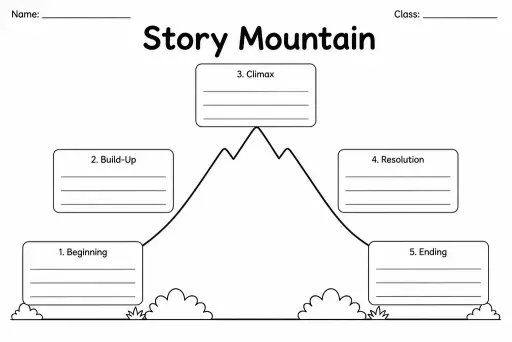
Story Mountain
Graphic Organizers
Ages 4–11
——
KiwiBee uses optional Google Analytics, Google Ads, and Meta Pixel cookies to understand adult visitors, measure completed sign-ups, and improve campaigns. Essential cookies always stay on. OpenAI’s ChatGPT Ads Pixel also measures page views and completed enquiries after advertising consent, and may use hashed contact details for matching. Privacy policy

Letter Formation Boxes is a blank grid template for PreK and Kindergarten students learning to form individual letters and numbers. Each box contains a small start dot in the top-left corner that cues children where to begin their stroke, providing a consistent visual anchor across every cell. Teachers write or stamp a model letter at the top of each column and students fill the remaining boxes with independent attempts, letting the frame prevent the oversized, drifting strokes common in early writers. This template is popular in handwriting intervention groups, morning fine-motor tubs, and early literacy centers. Parents use it for one-on-one home practice. Because no letters are pre-printed, a single sheet can target any character in any curriculum — simply fill in the top-row model before printing or have students copy it themselves.
The dot marks the top-left entry point of the box, reminding young writers to begin at the same location before each stroke — a habit that directly supports correct letter formation and left-to-right directionality.
Yes. The template is available in multiple grid scales. Larger boxes suit PreK and early Kindergarten students still developing grip control; smaller boxes are appropriate for late Kindergarten and Grade 1 writers.
The blank grid works alongside any curriculum — Handwriting Without Tears, Zaner-Bloser, D'Nealian, or school-created scope-and-sequence. Simply use your program's letter models in the first box.
The standard layout provides multiple rows with approximately 8–10 boxes per row, giving each student 7–9 independent practice attempts per letter on a single sheet.
See what other teachers think and share a helpful note.
Generate a fresh worksheet for any grade, topic and language. Free.
 Home
Home All solutions
 Pricing
 About us
 KiwiBee for Non-profits
 Events & webinars
 For big organisations
 For schools
 For centers
 For team leaders
 For teachers
 AI and resources
 Resources
 Printable worksheets
 Lesson Packs
 Interactive simulations
 Teacher tools
 AI studio
 Ideas and research