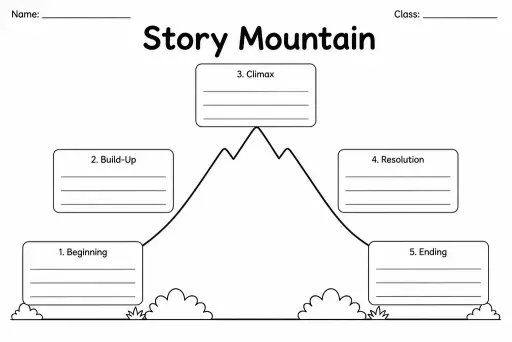
Story Mountain
Graphic Organizers
Ages 4–11
——
KiwiBee uses optional Google Analytics, Google Ads, and Meta Pixel cookies to understand adult visitors, measure completed sign-ups, and improve campaigns. Essential cookies always stay on. OpenAI’s ChatGPT Ads Pixel also measures page views and completed enquiries after advertising consent, and may use hashed contact details for matching. Privacy policy

A haiku template provides three ruled lines with a small syllable-count reminder (5 – 7 – 5) printed beside each row, giving students in grades 3–7 a clean, uncluttered space to compose a traditional three-line poem. The format is ideal for introducing the concept of syllable constraints without the intimidation of longer verse forms. Teachers reach for it during nature units, mindfulness moments, seasonal transitions, or any lesson where a short, focused writing task is needed. Because haiku is so compressed, students must weigh every word — it quietly drives vocabulary and editing skills without feeling like a grammar exercise. The template usually fits multiple drafts on one page, encouraging revision rather than treating the first attempt as final.
The template shows 5-7-5 as a guide, but for grades 3–4 you can relax the count to 'short-long-short' lines and focus on imagery first. Tighter adherence to syllable counts is more appropriate from grade 5 upward.
Yes. Haiku can be written in any language. Note that syllable-counting conventions differ by language, so adjust the guidance labels accordingly.
The template works best with a sensory prompt — a picture, an object on the desk, or a word from the current unit. Haiku traditionally focuses on a single moment in nature, so grounding the prompt in something visible helps.
Most versions leave a blank box below the three lines for a small sketch. This optional illustration step reinforces the image-based nature of haiku and appeals to visual learners.
See what other teachers think and share a helpful note.
Generate a fresh worksheet for any grade, topic and language. Free.
 Home
Home All solutions
 Pricing
 About us
 KiwiBee for Non-profits
 Events & webinars
 For big organisations
 For schools
 For centers
 For team leaders
 For teachers
 AI and resources
 Resources
 Printable worksheets
 Lesson Packs
 Interactive simulations
 Teacher tools
 AI studio
 Ideas and research