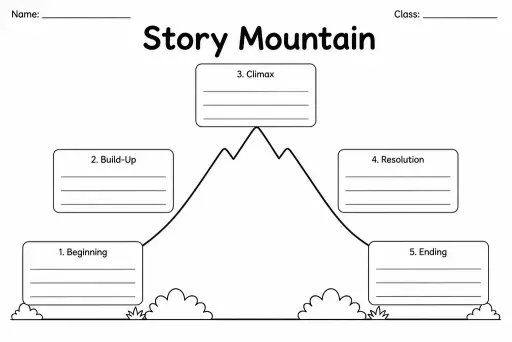
Story Mountain
Graphic Organizers
Ages 4–11
——
KiwiBee uses optional Google Analytics, Google Ads, and Meta Pixel cookies to understand adult visitors, measure completed sign-ups, and improve campaigns. Essential cookies always stay on. OpenAI’s ChatGPT Ads Pixel also measures page views and completed enquiries after advertising consent, and may use hashed contact details for matching. Privacy policy

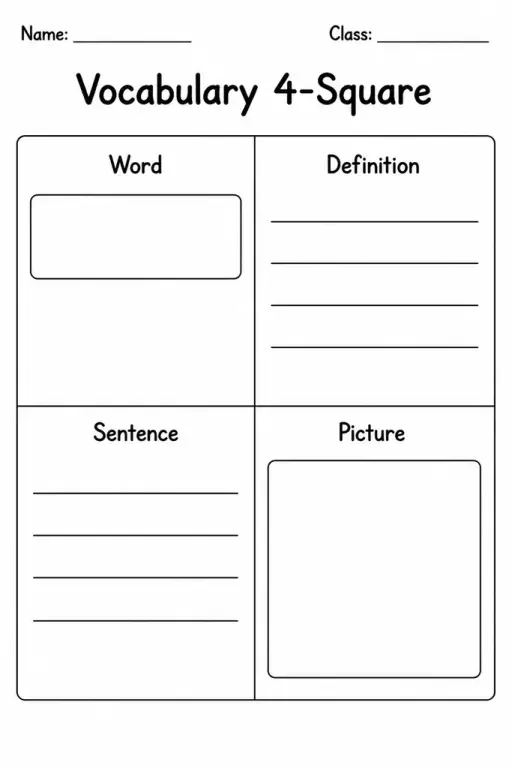
The Frayer Model is a four-square vocabulary graphic organizer built around a central oval. Students write a target word in the middle oval, then fill each quadrant: Definition (in their own words), Characteristics, Examples, and Non-Examples. This structure pushes beyond simple look-it-up definitions and builds genuine word ownership. Designed for grades 2–8, the template suits any subject where precise vocabulary matters — science terms, math concepts, social studies vocabulary, or literary devices in language arts. Teachers use it as a pre-reading warm-up, a during-reading anchor, or a post-reading review check. Because every box demands a different type of thinking, a single completed Frayer Model demonstrates deep word knowledge far more reliably than a dictionary copy-out.
Characteristics describe defining features of the concept (e.g., for 'mammal': warm-blooded, has fur, nurses young). Examples are specific instances of the concept (e.g., dog, whale, bat). Both boxes work together to build a complete mental picture.
Absolutely. Multi-word concepts like 'carrying capacity', 'point of view', or 'supply and demand' work just as well as single vocabulary words — place the full phrase in the central oval.
Yes, with scaffolding. For early grades, teachers can pre-write the definition as a class and have students draw examples and non-examples rather than write them.
A guided completion takes 8–12 minutes for most students in grades 4 and up. For grades 2–3, allow 15–20 minutes with teacher support or partner discussion built in.
See what other teachers think and share a helpful note.
Generate a fresh worksheet for any grade, topic and language. Free.
 Home
Home All solutions
 Pricing
 About us
 KiwiBee for Non-profits
 Events & webinars
 For big organisations
 For schools
 For centers
 For team leaders
 For teachers
 AI and resources
 Resources
 Printable worksheets
 Lesson Packs
 Interactive simulations
 Teacher tools
 AI studio
 Ideas and research