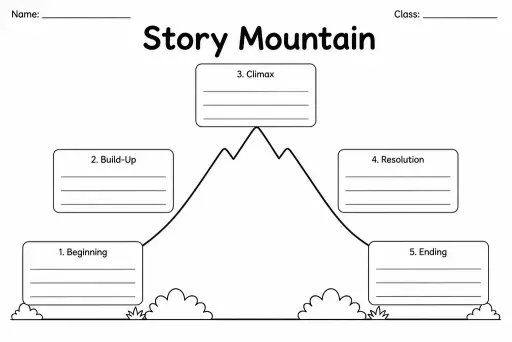
Story Mountain
Graphic Organizers
Ages 4–11
——
KiwiBee uses optional Google Analytics, Google Ads, and Meta Pixel cookies to understand adult visitors, measure completed sign-ups, and improve campaigns. Essential cookies always stay on. OpenAI’s ChatGPT Ads Pixel also measures page views and completed enquiries after advertising consent, and may use hashed contact details for matching. Privacy policy

The Five-Paragraph Essay Planner is a single-page planning frame divided into five clearly labelled sections: an introduction block, three numbered body-paragraph blocks, and a conclusion block. Each body section includes lines for a topic sentence and supporting details, while the introduction and conclusion sections prompt students for a thesis statement and a final restatement. Designed for Grades 5–8, the planner bridges the gap between knowing what an essay should look like and actually producing a coherent first draft. Middle-school teachers use it for literary analysis, persuasive essays, and research summaries — any task where students must sustain an argument or explanation across multiple paragraphs. By breaking the planning into five discrete boxes, the template makes a daunting essay feel like five manageable mini-tasks, building both confidence and writing stamina.
Yes. The five-paragraph structure is the most widely accepted format for timed writing assessments. Students who practise planning with this template can replicate the mental structure quickly even without the paper in an exam.
Easily — just instruct students to complete the introduction, one body paragraph, and the conclusion, leaving the other two body sections blank. The layout is flexible enough to work at different lengths.
The template is intentionally blank so it can be used for any subject or assignment. Teachers can write suggested sentence starters on the board or supply a separate prompt sheet alongside it.
English Language Arts is the most common use, but it is equally effective for social studies (historical argument essays), science (claim-evidence-reasoning), and even philosophy or ethics discussions.
See what other teachers think and share a helpful note.
Generate a fresh worksheet for any grade, topic and language. Free.
 Home
Home All solutions
 Pricing
 About us
 KiwiBee for Non-profits
 Events & webinars
 For big organisations
 For schools
 For centers
 For team leaders
 For teachers
 AI and resources
 Resources
 Printable worksheets
 Lesson Packs
 Interactive simulations
 Teacher tools
 AI studio
 Ideas and research