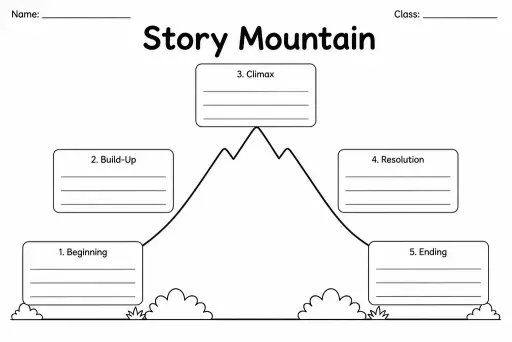
Story Mountain
Graphic Organizers
Ages 4–11
——
KiwiBee uses optional Google Analytics, Google Ads, and Meta Pixel cookies to understand adult visitors, measure completed sign-ups, and improve campaigns. Essential cookies always stay on. OpenAI’s ChatGPT Ads Pixel also measures page views and completed enquiries after advertising consent, and may use hashed contact details for matching. Privacy policy

A fishbone diagram — also called an Ishikawa diagram or cause-and-effect diagram — is a blank graphic organizer shaped like a fish skeleton. The fish head holds the central problem or effect, while the bones radiating off the spine label broad cause categories. Students in grades 4–8 fill in each branch with contributing factors, turning messy thinking into a clear visual web of relationships. This template is equally useful in science class for analyzing experimental errors, in social studies for examining historical events, and in writing for brainstorming story conflicts. Teachers project it on a whiteboard for whole-class discussion or distribute individual copies during guided inquiry. Because the structure is completely blank, it fits any subject or topic with no modification required.
It works for any subject where cause-and-effect analysis applies — science, history, language arts, health, math problem-solving, and even social-emotional learning discussions.
The blank template typically shows 4–6 main bones. Students can use as many or as few as the topic requires — some problems have three clear categories, others may need six.
Yes. Print one larger copy on A3 paper (or project it on a screen) and have groups annotate together, then report findings. Each student can also keep a personal copy for note-taking.
With brief teacher modeling — showing how to choose a fish-head topic and assign categories — grade 4 students handle it well. Pre-labeling the bone categories simplifies the task for emerging learners.
See what other teachers think and share a helpful note.
Generate a fresh worksheet for any grade, topic and language. Free.
 Home
Home All solutions
 Pricing
 About us
 KiwiBee for Non-profits
 Events & webinars
 For big organisations
 For schools
 For centers
 For team leaders
 For teachers
 AI and resources
 Resources
 Printable worksheets
 Lesson Packs
 Interactive simulations
 Teacher tools
 AI studio
 Ideas and research