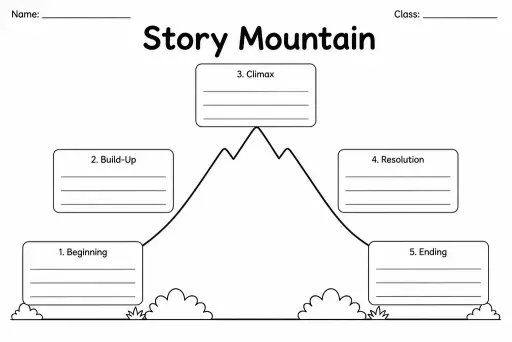
Story Mountain
Graphic Organizers
Ages 4–11
——
KiwiBee uses optional Google Analytics, Google Ads, and Meta Pixel cookies to understand adult visitors, measure completed sign-ups, and improve campaigns. Essential cookies always stay on. OpenAI’s ChatGPT Ads Pixel also measures page views and completed enquiries after advertising consent, and may use hashed contact details for matching. Privacy policy

The Fact and Opinion Chart is a clean two-column graphic organizer designed to help students in grades 2–6 separate what can be proven from what someone believes or feels. The left column collects statements that are verifiable with evidence; the right column holds personal judgments, preferences, or interpretations. Teachers reach for this template during reading comprehension lessons, news literacy units, or debates, while students use it independently when analyzing nonfiction passages or advertisements. Because the chart is completely blank, it adapts to any subject—science claims, historical arguments, or even sentences from a picture book. Printing a fresh copy takes seconds, and the simple two-column layout keeps younger readers focused without visual clutter.
The template works best from grade 2 upward when students can read independently. For younger learners, a teacher can read aloud and scribe, making it a whole-class anchor activity rather than an independent one.
That ambiguity is a great teaching moment. Encourage students to underline the factual part and circle the opinion part within the same statement, then place it in the column that best represents the dominant purpose.
Not at all. It works well in social studies (historical claims), science (hypothesis versus observation), and even math class when discussing reasonableness of estimates.
If you laminate the sheet or slip it into a dry-erase pocket, students can use dry-erase markers and wipe it clean after each session, making it reusable indefinitely.
See what other teachers think and share a helpful note.
Generate a fresh worksheet for any grade, topic and language. Free.
 Home
Home All solutions
 Pricing
 About us
 KiwiBee for Non-profits
 Events & webinars
 For big organisations
 For schools
 For centers
 For team leaders
 For teachers
 AI and resources
 Resources
 Printable worksheets
 Lesson Packs
 Interactive simulations
 Teacher tools
 AI studio
 Ideas and research