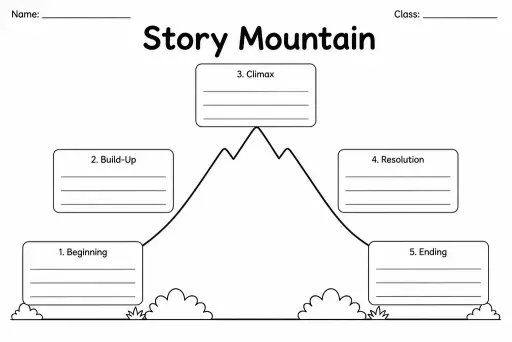
Story Mountain
Graphic Organizers
Ages 4–11
——
KiwiBee uses optional Google Analytics, Google Ads, and Meta Pixel cookies to understand adult visitors, measure completed sign-ups, and improve campaigns. Essential cookies always stay on. OpenAI’s ChatGPT Ads Pixel also measures page views and completed enquiries after advertising consent, and may use hashed contact details for matching. Privacy policy

A Double Bubble Map lays two subjects side by side, each with its own central circle, and arranges smaller bubbles around them. Bubbles that appear between the two centres show shared traits, while bubbles on the outer edges belong exclusively to one subject. This layout makes compare-and-contrast thinking immediate and visual — students can see at a glance what the two subjects share and what sets them apart. In grades 2 through 7, teachers use it across every subject: comparing two historical figures, two animals, two story characters, or two geometric solids. Because no topic names or labels are printed, the blank template is ready for any pair of subjects the lesson requires.
Both show similarities and differences, but the double bubble map uses individual bubbles for each trait rather than overlapping circles. Many students find it easier to place discrete details in separate bubbles.
The standard template is designed for two subjects. For three-way comparisons, students can use a Triple Venn diagram or connect a third bubble cluster by hand.
It works well from grade 2 upward. Younger students compare concrete objects or story characters; older students handle abstract comparisons such as two political systems or scientific theories.
The template includes two central circles plus several surrounding bubbles on each side and between the centres. Students can draw additional bubbles by hand if their comparison requires more detail.
See what other teachers think and share a helpful note.
Generate a fresh worksheet for any grade, topic and language. Free.
 Home
Home All solutions
 Pricing
 About us
 KiwiBee for Non-profits
 Events & webinars
 For big organisations
 For schools
 For centers
 For team leaders
 For teachers
 AI and resources
 Resources
 Printable worksheets
 Lesson Packs
 Interactive simulations
 Teacher tools
 AI studio
 Ideas and research