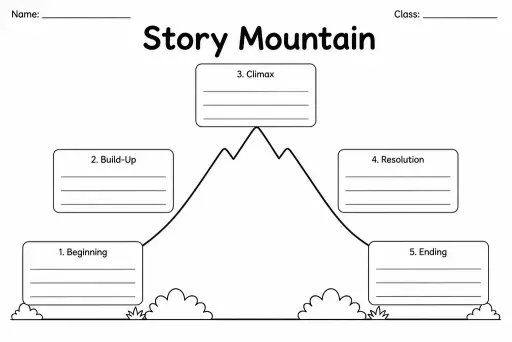
Story Mountain
Graphic Organizers
Ages 4–11
——
KiwiBee uses optional Google Analytics, Google Ads, and Meta Pixel cookies to understand adult visitors, measure completed sign-ups, and improve campaigns. Essential cookies always stay on. OpenAI’s ChatGPT Ads Pixel also measures page views and completed enquiries after advertising consent, and may use hashed contact details for matching. Privacy policy

The Diary Entry Template opens with the classic "Dear Diary" salutation printed at the top, followed by a date line and a full page of blank writing lines, giving students in Grades 2 through 6 an immediate sense of personal, first-person voice before they write a single word. The familiar frame lowers the barrier for reluctant writers by grounding the task in a recognizable genre. Teachers use it for personal narrative units, character perspective exercises, and historical empathy projects — asking students to write as a historical figure or a character from a novel. Parents find it useful for encouraging home writing outside of school assignments. The structure signals privacy and ownership in a way that plain lined paper does not, making students more willing to write honestly and at length.
The pre-printed 'Dear Diary' opener and dedicated date line signal a specific genre — personal diary writing — which gives students an immediate voice and lowers the intimidation of a blank page.
Absolutely. The template is widely used for character perspective exercises where students inhabit a fictional or historical person and write as that character.
Yes. The wide ruling and generous line spacing accommodate both careful print and early cursive handwriting comfortable for second graders.
Have students fold the page in half and place it face-down in a collection box — or keep diary booklets at home — to signal that only the student (and optionally you) will read them.
See what other teachers think and share a helpful note.
Generate a fresh worksheet for any grade, topic and language. Free.
 Home
Home All solutions
 Pricing
 About us
 KiwiBee for Non-profits
 Events & webinars
 For big organisations
 For schools
 For centers
 For team leaders
 For teachers
 AI and resources
 Resources
 Printable worksheets
 Lesson Packs
 Interactive simulations
 Teacher tools
 AI studio
 Ideas and research