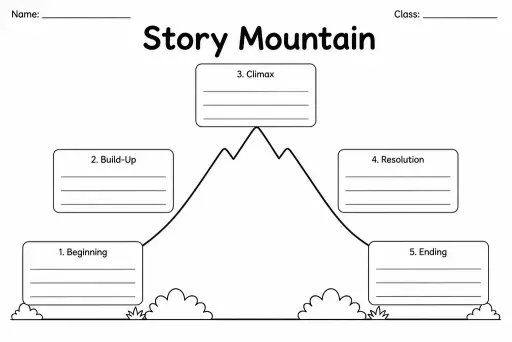
Story Mountain
Graphic Organizers
Ages 4–11
——
KiwiBee uses optional Google Analytics, Google Ads, and Meta Pixel cookies to understand adult visitors, measure completed sign-ups, and improve campaigns. Essential cookies always stay on. OpenAI’s ChatGPT Ads Pixel also measures page views and completed enquiries after advertising consent, and may use hashed contact details for matching. Privacy policy

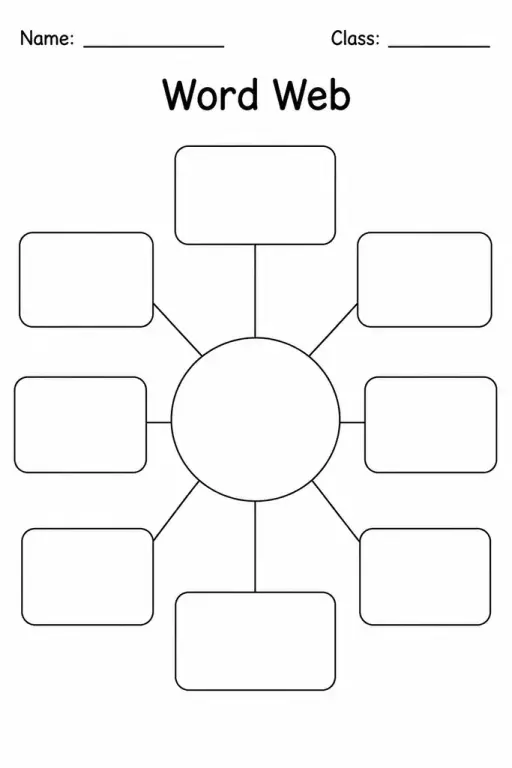
A Concept Map is a graphic organizer built from blank nodes connected by labeled or unlabeled linking lines. Unlike a mind map that radiates from one centre, a concept map can show complex, multi-directional relationships between ideas — for example, how a cause connects to multiple effects, or how several scientific terms relate to each other. Students in grades 3 through 8 use it to demonstrate deep understanding of a topic rather than simply listing facts. Teachers assign it after instruction to assess whether students can articulate how ideas are connected, not just name them. The template arrives fully blank so learners place and label every node themselves, making the thinking process genuinely their own.
A concept map shows relationships in multiple directions and labels the connecting lines to explain how concepts relate. A mind map typically radiates outward from one centre without labeled connectors.
A brief teacher modelling session is helpful the first time. Once students understand that lines represent relationships and those relationships can be named, most pick it up quickly.
There is no fixed rule. A good concept map usually has between 6 and 20 nodes depending on the topic's complexity and the student's grade level.
Yes. Students can map related formulas, properties of shapes, or relationships within a number system using nodes and labeled connectors just as effectively as in science or social studies.
See what other teachers think and share a helpful note.
Generate a fresh worksheet for any grade, topic and language. Free.
 Home
Home All solutions
 Pricing
 About us
 KiwiBee for Non-profits
 Events & webinars
 For big organisations
 For schools
 For centers
 For team leaders
 For teachers
 AI and resources
 Resources
 Printable worksheets
 Lesson Packs
 Interactive simulations
 Teacher tools
 AI studio
 Ideas and research