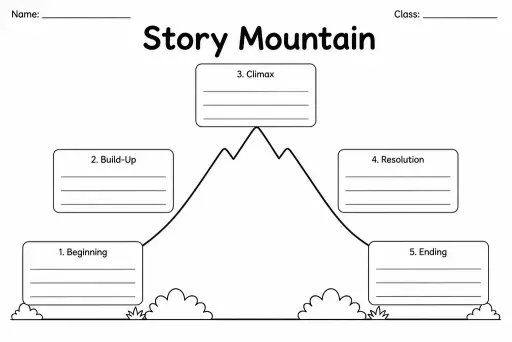
Story Mountain
Graphic Organizers
Ages 4–11
——
KiwiBee uses optional Google Analytics, Google Ads, and Meta Pixel cookies to understand adult visitors, measure completed sign-ups, and improve campaigns. Essential cookies always stay on. OpenAI’s ChatGPT Ads Pixel also measures page views and completed enquiries after advertising consent, and may use hashed contact details for matching. Privacy policy

The Circle Map (Define in Context) is a blank graphic organizer made up of two concentric circles. The inner circle is for the topic, word, or idea being defined; the outer ring is for all the contextual information — examples, characteristics, prior knowledge, and associations — that gives that concept meaning. A square frame around both circles provides space for students to note the context or frame of reference that shaped their thinking. Teachers use it to activate background knowledge at the start of a unit, to build vocabulary depth, or to help students brainstorm what they already know before research. Students in Grades 1–6 find the simple circular structure intuitive: the inner circle anchors the focus, and the outer ring fills naturally with ideas during class discussion or independent thinking time.
The inner circle holds only the subject being defined — a single word, phrase, or concept. The outer ring holds all the context: descriptions, characteristics, examples, synonyms, drawings, or facts that help explain what that subject means.
The square frame (sometimes called the 'frame of reference') is where students record the context that shaped their definition — for example, 'what I read in Chapter 3,' 'my personal experience,' or 'what my teacher explained.' It reminds students that definitions change depending on context.
Yes. Young students can draw pictures in the outer ring rather than writing words, and teachers can use it as a shared class chart on the whiteboard during whole-group instruction.
Absolutely. Many teachers use it as a free-form brainstorm tool — any topic goes in the centre, and every related thought fills the ring. It works equally well for pre-writing, discussion starters, and end-of-unit review.
See what other teachers think and share a helpful note.
Generate a fresh worksheet for any grade, topic and language. Free.
 Home
Home All solutions
 Pricing
 About us
 KiwiBee for Non-profits
 Events & webinars
 For big organisations
 For schools
 For centers
 For team leaders
 For teachers
 AI and resources
 Resources
 Printable worksheets
 Lesson Packs
 Interactive simulations
 Teacher tools
 AI studio
 Ideas and research