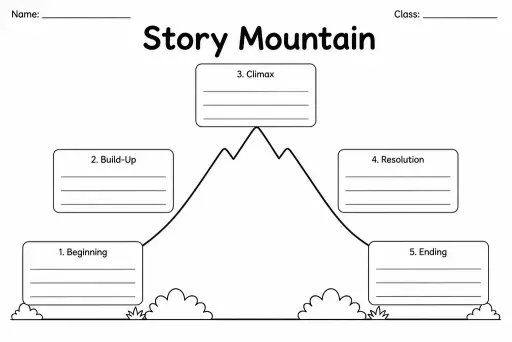
Story Mountain
Graphic Organizers
Ages 4–11
——
KiwiBee uses optional Google Analytics, Google Ads, and Meta Pixel cookies to understand adult visitors, measure completed sign-ups, and improve campaigns. Essential cookies always stay on. OpenAI’s ChatGPT Ads Pixel also measures page views and completed enquiries after advertising consent, and may use hashed contact details for matching. Privacy policy

A Character Map is a blank graphic organizer centered on a drawn or sketched figure — usually a simple outline of a person — with labeled zones radiating outward for physical traits, personality traits, actions, and feelings. Students record evidence from the text in each zone, building a complete, evidence-grounded portrait of a fictional or historical person. Used widely in Grades 1 through 6, this template suits independent reading response, guided reading groups, and whole-class novel studies. Teachers assign it to help students move beyond surface-level character description toward inference-based character analysis. The four distinct zones prevent students from conflating how a character looks with how a character thinks. Parents doing home reading with a child also find the map useful because the visual layout makes literary conversation concrete and accessible for early readers.
A Character Traits worksheet typically lists adjectives for students to circle or match. The Character Map asks students to generate and categorize their own observations across four distinct dimensions — appearance, personality, actions, and feelings — making it an open-ended thinking tool rather than a fill-in activity.
With scaffolding, yes. Teacher-led first use on a read-aloud is recommended for Grades 1 and 2. Students can draw pictures in the trait zones instead of writing words, and the teacher can scribe as students dictate their observations.
Students can write the feeling and then note the chapter or scene in brackets — for example, 'scared (ch. 1) → brave (ch. 7)'. This variation actually deepens analysis by showing character growth, which is a key comprehension standard.
Yes, particularly for biography, autobiography, and historical narrative. The four zones translate naturally — appearance can cover physical description from photos or accounts, and the actions/feelings zones work well for analysing a real person's documented decisions and stated motivations.
See what other teachers think and share a helpful note.
Generate a fresh worksheet for any grade, topic and language. Free.
 Home
Home All solutions
 Pricing
 About us
 KiwiBee for Non-profits
 Events & webinars
 For big organisations
 For schools
 For centers
 For team leaders
 For teachers
 AI and resources
 Resources
 Printable worksheets
 Lesson Packs
 Interactive simulations
 Teacher tools
 AI studio
 Ideas and research