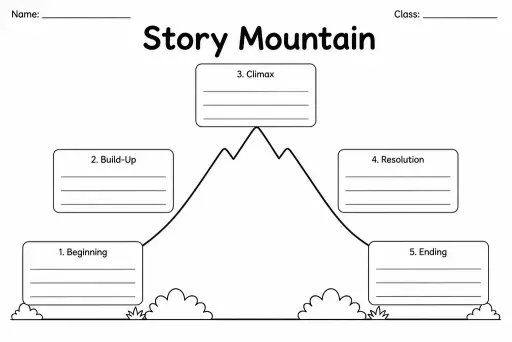
Story Mountain
Graphic Organizers
Ages 4–11
——
KiwiBee uses optional Google Analytics, Google Ads, and Meta Pixel cookies to understand adult visitors, measure completed sign-ups, and improve campaigns. Essential cookies always stay on. OpenAI’s ChatGPT Ads Pixel also measures page views and completed enquiries after advertising consent, and may use hashed contact details for matching. Privacy policy

The Bridge Map (Analogies) is a blank graphic organizer built around a horizontal bridge shape. A relating factor — the rule or relationship that connects two things — is written on the bridge support, and pairs of related terms are placed on each span of the bridge. Each new span extends the analogy to a fresh pair, making the underlying relationship visible across multiple examples at once. ELA teachers use it to teach analogical reasoning and vocabulary relationships (synonym, antonym, part-to-whole, function). Science and social-studies teachers use it to build conceptual connections across topics (atom:molecule as cell:tissue). Students in Grades 3–8 find it valuable for standardised-test analogy questions and for deepening content understanding by recognising recurring patterns. Because all fields are blank, the template works for any subject and any type of relationship.
The relating factor is the rule or relationship that makes both items in each pair connected in the same way. It is written on the slanted bridge support line that runs underneath all the spans, making it clear that the same rule applies to every pair on the map.
The standard printable has four spans, allowing four analogy pairs under one relating factor. For lessons needing more pairs, students can extend the bridge on a wider sheet of paper or tape two copies together.
A Double Bubble Map compares two specific things by listing similarities and differences. A Bridge Map does not compare two things — it shows the same type of relationship repeating across multiple pairs, emphasising the pattern of the relationship itself.
Yes, with teacher support. At Grade 3 a teacher typically introduces the relating factor aloud and provides the first completed span as a model, then asks students to generate one or two new pairs independently.
See what other teachers think and share a helpful note.
Generate a fresh worksheet for any grade, topic and language. Free.
 Home
Home All solutions
 Pricing
 About us
 KiwiBee for Non-profits
 Events & webinars
 For big organisations
 For schools
 For centers
 For team leaders
 For teachers
 AI and resources
 Resources
 Printable worksheets
 Lesson Packs
 Interactive simulations
 Teacher tools
 AI studio
 Ideas and research