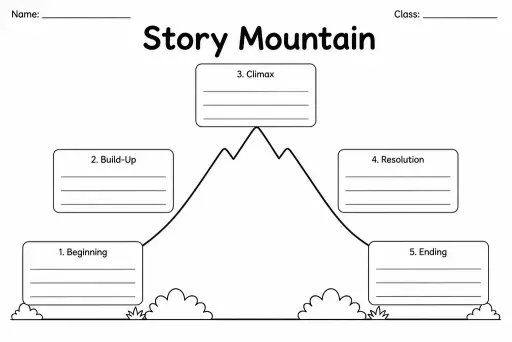
Story Mountain
Graphic Organizers
Ages 4–11
——
KiwiBee uses optional Google Analytics, Google Ads, and Meta Pixel cookies to understand adult visitors, measure completed sign-ups, and improve campaigns. Essential cookies always stay on. OpenAI’s ChatGPT Ads Pixel also measures page views and completed enquiries after advertising consent, and may use hashed contact details for matching. Privacy policy

The Brace Map (Whole-Part) is a blank graphic organizer that uses nested brace brackets to show how a whole object or concept is physically made up of its parts. A label for the whole sits on the left; the first-level braces break it into major parts; a second set of braces can subdivide those parts into sub-parts. The visual nesting mirrors the actual physical structure of whatever is being analysed. Science teachers use it to decompose a plant into roots, stem, leaves, and flower, then break each part into sub-structures. English teachers use it to map a book into chapters and scenes. Students in Grades 2–7 find it especially useful when studying anatomy, geography (a country broken into regions and cities), or engineering design. Because every label is blank, the same printable handles any concrete object or system.
A Brace Map is specifically for physical, structural part-whole relationships (how something is physically built). A Tree Map is for classification (grouping things by shared traits). Use a Brace Map when you can point to the parts inside the object; use a Tree Map when you are sorting items into categories.
The standard printable includes two brace levels — major parts and sub-parts. For simple analyses a single level is enough; for complex subjects both levels can be filled in.
Brace Maps work best with concrete, physical structures. For abstract concepts with logical sub-divisions (like 'democracy' broken into principles), a Tree Map or outline is usually clearer.
Yes. Younger students can draw or paste pictures in the brace labels instead of writing words, and teachers can pre-fill the whole and first-level parts to focus attention on just one level of analysis.
See what other teachers think and share a helpful note.
Generate a fresh worksheet for any grade, topic and language. Free.
 Home
Home All solutions
 Pricing
 About us
 KiwiBee for Non-profits
 Events & webinars
 For big organisations
 For schools
 For centers
 For team leaders
 For teachers
 AI and resources
 Resources
 Printable worksheets
 Lesson Packs
 Interactive simulations
 Teacher tools
 AI studio
 Ideas and research