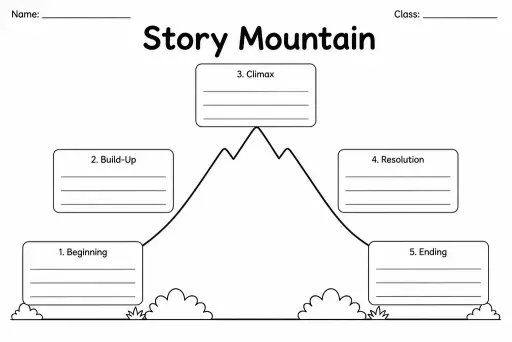
Story Mountain
Graphic Organizers
Ages 4–11
——
KiwiBee uses optional Google Analytics, Google Ads, and Meta Pixel cookies to understand adult visitors, measure completed sign-ups, and improve campaigns. Essential cookies always stay on. OpenAI’s ChatGPT Ads Pixel also measures page views and completed enquiries after advertising consent, and may use hashed contact details for matching. Privacy policy

The Beginning-Middle-End template presents three stacked blank boxes — one for each core section of a story. It is the simplest possible narrative organizer, designed for PreK through grade 3 students who are just learning that stories have a sequence and that every part carries a different role. Teachers use it after picture-book read-alouds to prompt retelling, as a planning sheet before a first writing draft, and as a home-reading comprehension tool for parents. The three-box format removes visual clutter so the youngest learners can focus on the idea itself rather than the page layout. Students may draw pictures, write single words, short phrases, or full sentences in each box — making this one template genuinely usable from pre-reading age through early chapter books.
It is designed for PreK through grade 3. Pre-K students typically draw in each box; kindergarten and grade 1 students mix drawing with labeling words; grades 2–3 write full sentences or short paragraphs.
Yes — informational picture books that follow a narrative thread (e.g., a day in the life of an animal) work well. For purely expository non-fiction, adjust the labels to 'First', 'Next', and 'Last' to match the text's structure.
For struggling writers, provide a sentence starter in each box (e.g., 'At the beginning, ___'). For advanced students, add a writing line below each box for a second sentence of detail.
Not necessarily — the Middle box often holds the most events, but each box should have at least one clear idea. Emphasis is on ensuring all three sections are present, not on equal length.
See what other teachers think and share a helpful note.
Generate a fresh worksheet for any grade, topic and language. Free.
 Home
Home All solutions
 Pricing
 About us
 KiwiBee for Non-profits
 Events & webinars
 For big organisations
 For schools
 For centers
 For team leaders
 For teachers
 AI and resources
 Resources
 Printable worksheets
 Lesson Packs
 Interactive simulations
 Teacher tools
 AI studio
 Ideas and research