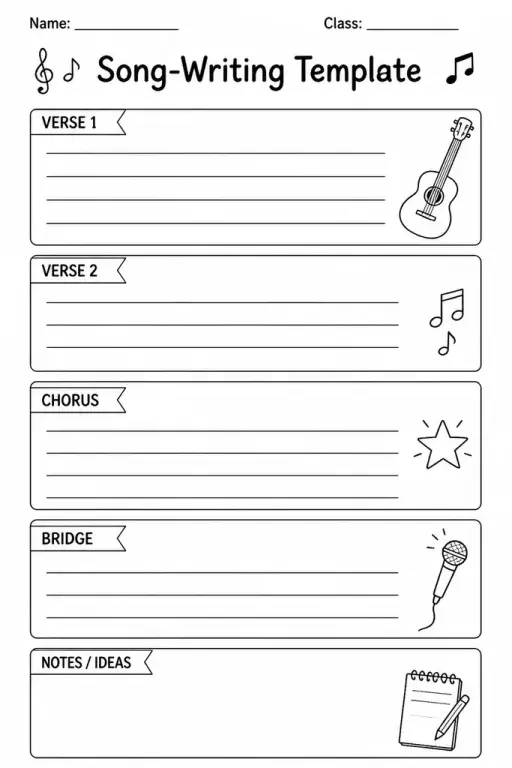
Song-Writing Template
Music Templates
Ages 4–11
——
KiwiBee uses optional Google Analytics, Google Ads, and Meta Pixel cookies to understand adult visitors, measure completed sign-ups, and improve campaigns. Essential cookies always stay on. OpenAI’s ChatGPT Ads Pixel also measures page views and completed enquiries after advertising consent, and may use hashed contact details for matching. Privacy policy

The Zentangle Frame template is a rectangular border divided into clearly outlined sections of varying shapes, giving students a contained canvas for practising Zentangle-inspired pattern drawing. Each section is sized to hold one distinct tangle pattern, so grades 3–8 can experiment with stippling, hatching, and organic forms without the intimidation of a blank page. Art teachers use it to introduce Zentangle as a low-stakes drawing technique; students who freeze in front of empty paper immediately relax when the space is pre-sectioned. Parents download it for rainy-day creative sessions. The frame format also doubles as a decorative border for certificates, posters, or written work displayed in the classroom.
A Zentangle frame uses blank sections that students fill with original repeating patterns they draw themselves, rather than colouring pre-drawn images. It builds drawing skills and creativity simultaneously.
No. The whole point of the sectioned frame is that each small area is approachable. Even students who say they 'can't draw' can fill a small section with dots, dashes, or wavy lines.
A Staedtler or Sakura fine-liner (0.1–0.5 mm) gives crisp lines. Softer pencils (2B–4B) work well for shading. Avoid felt-tip markers that bleed through paper.
Yes. Scanning at 300 dpi produces a high-quality image suitable for printing as a poster or inserting into digital portfolios and school newsletters.
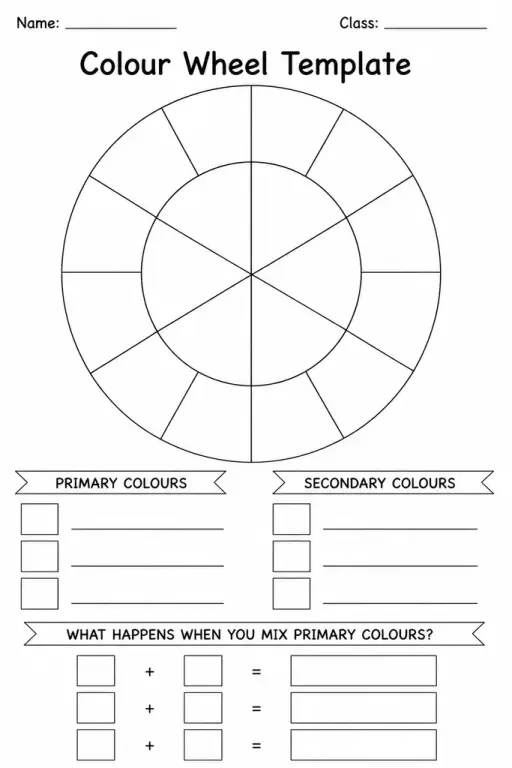

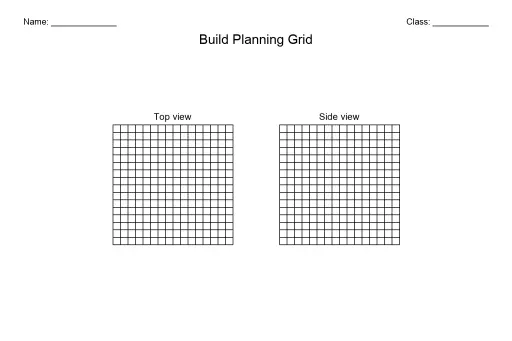
See what other teachers think and share a helpful note.
Generate a fresh worksheet for any grade, topic and language. Free.
 Home
Home All solutions
 Pricing
 About us
 KiwiBee for Non-profits
 Events & webinars
 For big organisations
 For schools
 For centers
 For team leaders
 For teachers
 AI and resources
 Resources
 Printable worksheets
 Lesson Packs
 Interactive simulations
 Teacher tools
 AI studio
 Ideas and research