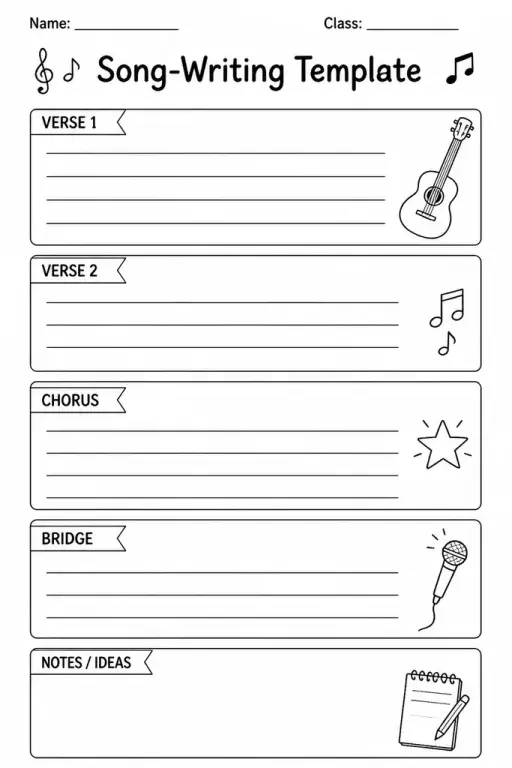
Song-Writing Template
Music Templates
Ages 4–11
——
KiwiBee uses optional Google Analytics, Google Ads, and Meta Pixel cookies to understand adult visitors, measure completed sign-ups, and improve campaigns. Essential cookies always stay on. OpenAI’s ChatGPT Ads Pixel also measures page views and completed enquiries after advertising consent, and may use hashed contact details for matching. Privacy policy

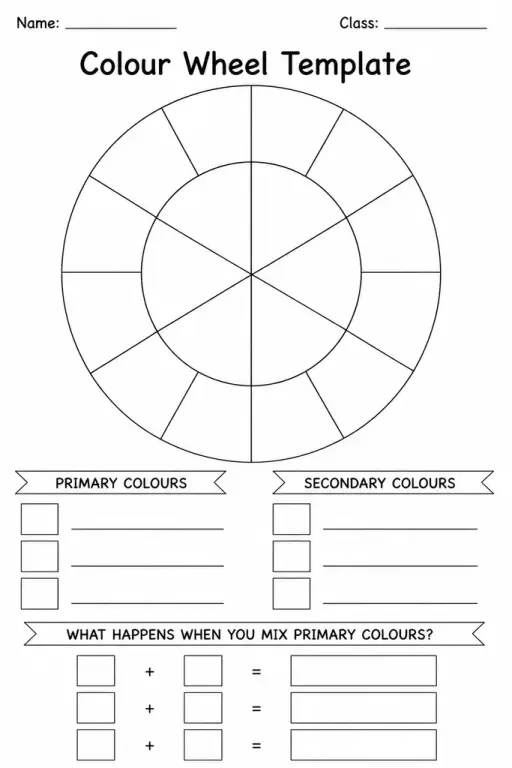
This two-zone sorting template presents a large warm-colour region and a large cool-colour region side by side, both completely blank so students fill, paint, or paste colour swatches where they belong. Designed for grades 2–6, it is the go-to handout for introducing the warm/cool colour split in any primary or intermediate art room. Teachers use it as a guided practise after a colour-theory mini-lesson, asking students to mix or swatch directly in the zones. Parents print it at home alongside a set of crayons so children can explore colour vocabulary independently. The open format means it works equally well as a sorting game (cut and paste colour chips) or a painting exercise (dab and label).
Warm colours are typically reds, oranges, and yellows. Cool colours are blues, greens, and violets. Colours like yellow-green or red-violet sit on the boundary and make great discussion starters.
It works best from grade 2 onward when students have enough colour vocabulary, but a simplified version using just red/orange/yellow versus blue/green can work for Year 1 with teacher guidance.
Yes. Open the PDF in an app like Procreate, Canva, or Google Slides and use the fill or brush tool to colour each zone digitally. It works well on tablets in a 1:1 device classroom.
The warm/cool split is the first step toward understanding colour relationships. After this template, students are ready to explore complementary pairs, analogous schemes, and colour harmony on a full colour wheel.

See what other teachers think and share a helpful note.
Generate a fresh worksheet for any grade, topic and language. Free.
 Home
Home All solutions
 Pricing
 About us
 KiwiBee for Non-profits
 Events & webinars
 For big organisations
 For schools
 For centers
 For team leaders
 For teachers
 AI and resources
 Resources
 Printable worksheets
 Lesson Packs
 Interactive simulations
 Teacher tools
 AI studio
 Ideas and research