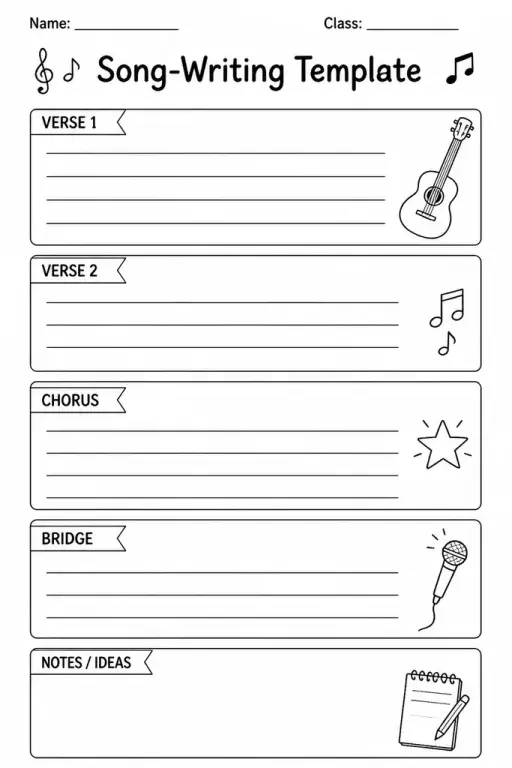
Song-Writing Template
Music Templates
Ages 4–11
——
KiwiBee uses optional Google Analytics, Google Ads, and Meta Pixel cookies to understand adult visitors, measure completed sign-ups, and improve campaigns. Essential cookies always stay on. OpenAI’s ChatGPT Ads Pixel also measures page views and completed enquiries after advertising consent, and may use hashed contact details for matching. Privacy policy

This symmetry drawing template provides a half-completed image on one side of a central line of symmetry, leaving the other half completely blank for students to mirror accurately. Depending on the version, the line of symmetry runs vertically down the centre, horizontally across the middle, or diagonally. The pre-drawn half might be a simple geometric shape, a butterfly wing, a face, a leaf, or an abstract design—giving students a clear and achievable completion task. Students in grades 1–6 use it to build understanding of reflective symmetry through hands-on drawing rather than abstract rules. Teachers use it across both art and maths lessons—it sits naturally in geometry units as well as observational-drawing practice. Because one half is already there, even reluctant drawers feel confident completing the task, and the finished result always looks satisfying.
Teach them to count grid squares or use a ruler to measure key points from the central line on the drawn side, then mark the same distance on the blank side. Connecting those points gives a reliable outline to refine.
Both. Maths teachers use it to make the concept of line symmetry concrete and visual. Art teachers use it to explore pattern, balance, and composition. It is an ideal cross-curricular resource.
Simpler versions feature bold geometric shapes or a single curved form—suitable for grades 1–2. More complex versions with intricate patterns, detailed faces, or overlapping shapes suit grades 4–6.
Yes—folding along the central line and holding it up to the light is a satisfying self-check method. Encourage students to do this before adding final colour so corrections are still easy to make.

See what other teachers think and share a helpful note.
Generate a fresh worksheet for any grade, topic and language. Free.
 Home
Home All solutions
 Pricing
 About us
 KiwiBee for Non-profits
 Events & webinars
 For big organisations
 For schools
 For centers
 For team leaders
 For teachers
 AI and resources
 Resources
 Printable worksheets
 Lesson Packs
 Interactive simulations
 Teacher tools
 AI studio
 Ideas and research