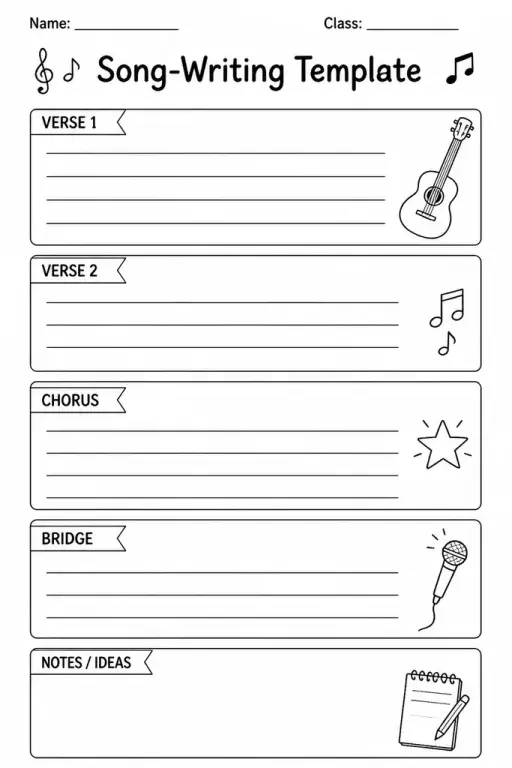
Song-Writing Template
Music Templates
Ages 4–11
——
KiwiBee uses optional Google Analytics, Google Ads, and Meta Pixel cookies to understand adult visitors, measure completed sign-ups, and improve campaigns. Essential cookies always stay on. OpenAI’s ChatGPT Ads Pixel also measures page views and completed enquiries after advertising consent, and may use hashed contact details for matching. Privacy policy

The Stained-Glass Window Template is a blank printable divided into irregular outlined sections that mimic the lead lines of a traditional stained-glass or mosaic window design. Students in kindergarten through grade 6 colour each section with a different hue, creating a vibrant, light-filled effect when finished. The outlined cells handle the compositional work so students can focus entirely on colour selection, blending, and the visual impact of adjacent colours. Teachers use it during colour theory lessons to explore warm and cool palettes, complementary pairs, or gradient progressions across sections. It also works beautifully as a seasonal display piece — Easter rose windows, autumn leaf mosaics, or holiday lantern scenes. Because no drawing skill is required, every student produces a polished-looking result, making it one of the most inclusive art templates for mixed-ability classrooms. Parents use it at home as a focused, meditative colouring activity.
Coloured pencils give fine control inside small sections; broad-tip markers produce vivid, saturated colour quickly; watercolour pencils can be blended with a damp brush for a translucent, glass-like effect. Avoid very watery paint on standard copy paper as it may warp.
No. Students are free to use any palette they choose. Teachers may suggest constraints (e.g. no two adjacent sections the same colour) to make the activity more intentional, but any colour choice produces a valid artwork.
Yes — look for versions with larger sections, which are easier for small hands to colour neatly. Kindergarten students may stay within the lines loosely, and that is fine; the process matters more than precision at that age.
Tape finished sheets to a window so natural light shines through for a genuine stained-glass glow. Alternatively, mount them on a black backing card and display on a bulletin board — the dark border mimics the lead frame effect.

See what other teachers think and share a helpful note.
Generate a fresh worksheet for any grade, topic and language. Free.
 Home
Home All solutions
 Pricing
 About us
 KiwiBee for Non-profits
 Events & webinars
 For big organisations
 For schools
 For centers
 For team leaders
 For teachers
 AI and resources
 Resources
 Printable worksheets
 Lesson Packs
 Interactive simulations
 Teacher tools
 AI studio
 Ideas and research