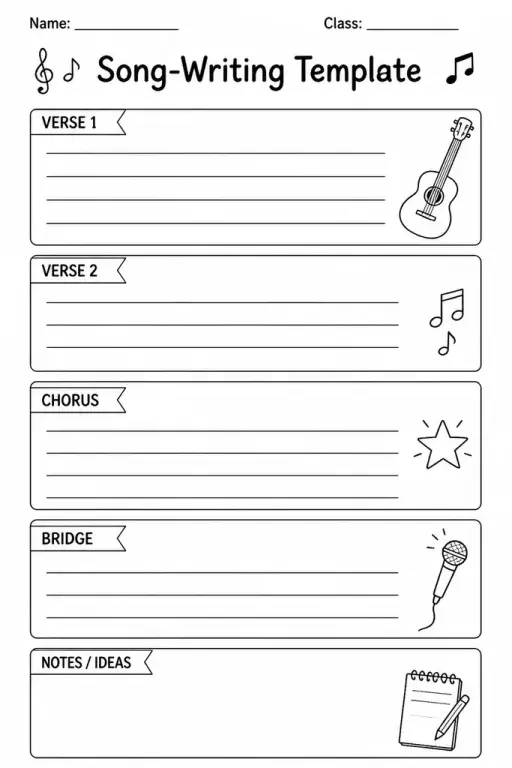
Song-Writing Template
Music Templates
Ages 4–11
——
KiwiBee uses optional Google Analytics, Google Ads, and Meta Pixel cookies to understand adult visitors, measure completed sign-ups, and improve campaigns. Essential cookies always stay on. OpenAI’s ChatGPT Ads Pixel also measures page views and completed enquiries after advertising consent, and may use hashed contact details for matching. Privacy policy

The Rhythm Composition Grid is a blank beat grid that gives students a visual canvas for writing and experimenting with rhythmic patterns. Each row represents a bar of music, and each cell stands for a beat or subdivision, so composers simply mark which beats are active to build up a rhythm from scratch. Students in grades 2–7 use it during music lessons when exploring meter, syncopation, or percussion arrangements. Because the grid is completely blank, it works equally well for 4/4, 3/4, or any time signature the teacher assigns. There is no pre-printed notation, so learners focus on the feel and logic of rhythm before tackling formal notation. It is lightweight enough to use as a warm-up, a creative exercise, or a self-assessment tool after listening to a piece.
No. The grid uses simple marking (X or dot) rather than standard notation, making it accessible to beginners from grade 2 upward.
Yes. Because the cells are blank, you can label the columns as beats in any meter — 4/4, 3/4, 6/8, or others — before printing or projecting.
The default layout provides eight rows, each representing one bar, giving enough space for a short, repeating rhythmic phrase.
Absolutely. Parents can print it for music homework; students only need a pencil to compose and can clap or tap the result at home.

See what other teachers think and share a helpful note.
Generate a fresh worksheet for any grade, topic and language. Free.
 Home
Home All solutions
 Pricing
 About us
 KiwiBee for Non-profits
 Events & webinars
 For big organisations
 For schools
 For centers
 For team leaders
 For teachers
 AI and resources
 Resources
 Printable worksheets
 Lesson Packs
 Interactive simulations
 Teacher tools
 AI studio
 Ideas and research