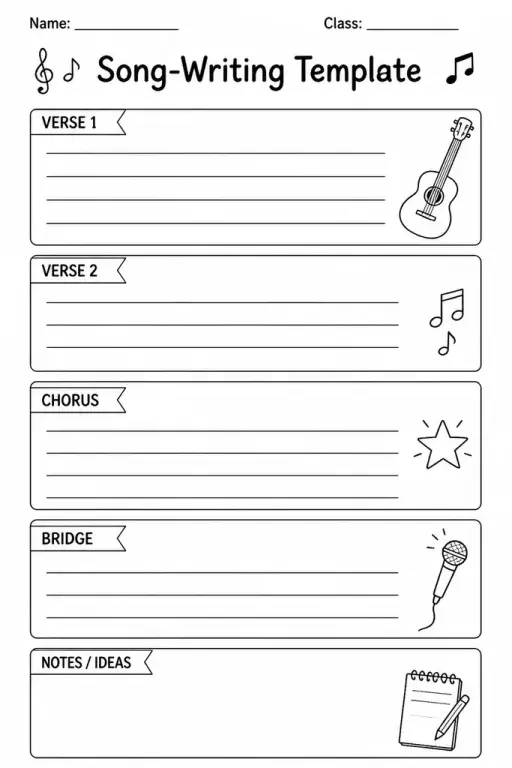
Song-Writing Template
Music Templates
Ages 4–11
——
KiwiBee uses optional Google Analytics, Google Ads, and Meta Pixel cookies to understand adult visitors, measure completed sign-ups, and improve campaigns. Essential cookies always stay on. OpenAI’s ChatGPT Ads Pixel also measures page views and completed enquiries after advertising consent, and may use hashed contact details for matching. Privacy policy

Guitar Tab Paper (Blank) is a printable sheet of six-line tablature grids designed for students in grades 4 through 8 who want to notate guitar music without reading traditional staff notation. Each grid's six horizontal lines represent the six guitar strings, and players write fret numbers directly on the lines to show which note to play. It is ideal for transcribing riffs, recording original compositions, sharing fingerpicking patterns with classmates, or annotating chord-melody arrangements. Teachers use it for popular-music units and after-school guitar club, while self-taught players at home value it for capturing ideas quickly before they are forgotten.
No. Tablature is a self-contained system—fret numbers on string lines are all you need to read and write it, making it very accessible for beginners.
Yes, with a small adjustment. Bass guitar has four strings, so use only the bottom four lines of the six-line grid and label them E, A, D, G.
Write standard note-value stems above the fret numbers, or add a separate rhythm slash line above the tab grid. Some players simply write the rhythm in plain text above each measure.
The layout typically fits six to eight six-line tab grids per page, which is enough for a 24- to 32-bar piece depending on how densely you write.

See what other teachers think and share a helpful note.
Generate a fresh worksheet for any grade, topic and language. Free.
 Home
Home All solutions
 Pricing
 About us
 KiwiBee for Non-profits
 Events & webinars
 For big organisations
 For schools
 For centers
 For team leaders
 For teachers
 AI and resources
 Resources
 Printable worksheets
 Lesson Packs
 Interactive simulations
 Teacher tools
 AI studio
 Ideas and research