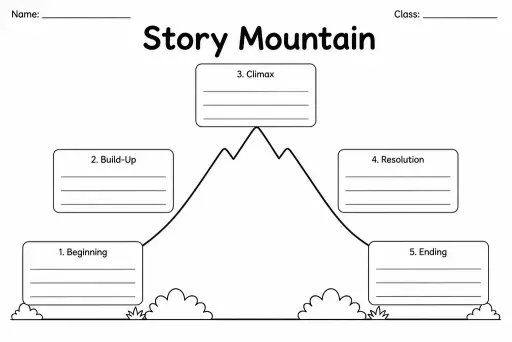
Story Mountain
Graphic Organizers
Ages 4–11
——
KiwiBee uses optional Google Analytics, Google Ads, and Meta Pixel cookies to understand adult visitors, measure completed sign-ups, and improve campaigns. Essential cookies always stay on. OpenAI’s ChatGPT Ads Pixel also measures page views and completed enquiries after advertising consent, and may use hashed contact details for matching. Privacy policy

This blank formal letter template gives students a ready-made frame for writing professional correspondence. Clearly labelled sections guide writers through the sender's address, date, recipient's address, salutation, body paragraphs, complimentary close, and signature line — every structural element a formal letter requires. Students in grades 3–8 use it for English language arts assignments, persuasive writing tasks, and real-world projects such as writing to a local official or requesting information from an organisation. Teachers print one copy per student or project it on screen during a mini-lesson to model the correct format before independent practice. The consistent layout removes formatting guesswork, letting writers focus on tone, vocabulary, and purpose. Reprint as many times as needed — the template never expires.
It is designed for grades 3–8. Younger students in grade 3 focus on basic structure, while grades 6–8 practise nuanced tone and complex body paragraphs.
Yes. The PDF can be filled in digitally using any annotation app, Google Drive, or Word, making it suitable for paperless classrooms.
No — it is intentionally blank so students fill in their own content. Teachers can create a separate example using the same layout to model before practice.
The structure matches the formal-letter conventions referenced in CCSS ELA Writing standards (W.3–8) and similar national curricula covering formal correspondence.
See what other teachers think and share a helpful note.
Generate a fresh worksheet for any grade, topic and language. Free.
 Home
Home All solutions
 Pricing
 About us
 KiwiBee for Non-profits
 Events & webinars
 For big organisations
 For schools
 For centers
 For team leaders
 For teachers
 AI and resources
 Resources
 Printable worksheets
 Lesson Packs
 Interactive simulations
 Teacher tools
 AI studio
 Ideas and research