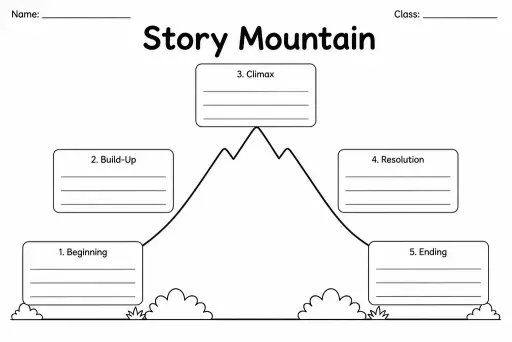
Story Mountain
Graphic Organizers
Ages 4–11
——
KiwiBee uses optional Google Analytics, Google Ads, and Meta Pixel cookies to understand adult visitors, measure completed sign-ups, and improve campaigns. Essential cookies always stay on. OpenAI’s ChatGPT Ads Pixel also measures page views and completed enquiries after advertising consent, and may use hashed contact details for matching. Privacy policy

Cursive Handwriting Lines is a blank guideline template for Grades 2–5 students learning joined script. The page features the three-line system — baseline, mid line, and ascender/descender space — scaled for the slightly tighter letter height appropriate for cursive practice. Unlike standard manuscript paper, the mid line sits proportionally lower to support the slant and loop forms that cursive letters require. Teachers assign a letter, word, or sentence at the top and students complete the remaining rows independently. This template suits direct instruction lessons, independent seat work, and take-home nightly practice. It is curriculum-neutral, so it pairs with D'Nealian, Zaner-Bloser, Spencerian, or any school-adopted cursive scope and sequence. Because every row is blank, the same sheet works equally well for isolated letter drills, connecting-letter practice, and full-sentence copy work.
The guide rows are proportioned specifically for cursive — the mid line is positioned to support the shorter x-height of joined script, and adequate descender space is built in for letters like g, y, and p.
Yes. The blank guideline format works equally well for left-handed writers. You may want to discuss paper angle with them and consider positioning the model sentence on the right side of the row rather than the left.
Absolutely. Adults returning to cursive or learning it for the first time find the clearly spaced guide rows helpful. The template has no grade-level imagery, so it feels appropriate for any age.
Grade 2 students typically need wider spacing (roughly 12–16 mm between baseline and mid line) as they are first learning joins. By Grades 4–5 students can work on narrower spacing closer to adult handwriting scale.
See what other teachers think and share a helpful note.
Generate a fresh worksheet for any grade, topic and language. Free.
 Home
Home All solutions
 Pricing
 About us
 KiwiBee for Non-profits
 Events & webinars
 For big organisations
 For schools
 For centers
 For team leaders
 For teachers
 AI and resources
 Resources
 Printable worksheets
 Lesson Packs
 Interactive simulations
 Teacher tools
 AI studio
 Ideas and research