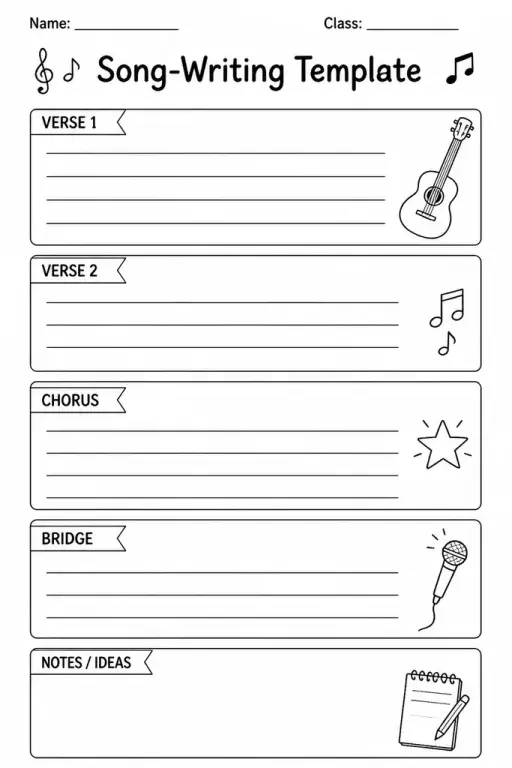
Song-Writing Template
Music Templates
Ages 4–11
——
KiwiBee uses optional Google Analytics, Google Ads, and Meta Pixel cookies to understand adult visitors, measure completed sign-ups, and improve campaigns. Essential cookies always stay on. OpenAI’s ChatGPT Ads Pixel also measures page views and completed enquiries after advertising consent, and may use hashed contact details for matching. Privacy policy

The Colour Wheel Template is a clean, blank circular wheel divided into the standard twelve segments used in colour theory. Students in grades 2–8 paint or colour each segment themselves, starting with the three primaries, mixing secondaries in between, and working outward to the six tertiaries — making colour relationships visible through their own hands-on process rather than a pre-printed chart. Art teachers use it as the cornerstone lesson of a colour-theory unit; classroom teachers draw on it for cross-curricular science discussions about light and pigment. The unlabelled segments mean students must recall or discover each colour name themselves, reinforcing memory. Because the wheel is blank, it is equally useful as an initial exploration, a formative check mid-unit, or a reference tool students keep in their art folder all year.
The standard template has twelve equal segments, covering all three primaries, three secondaries, and six tertiaries in the traditional RYB artist's colour wheel.
Yes. Coloured pencils, markers, oil pastels, and watercolour all work well. With coloured pencils, students can layer and blend adjacent hues directly in the segment to approximate mixed colours.
This is the blank version — segments are unlabelled so students practise recall. If you need labelled segments for younger students or as a reference poster, pair it with a labelled colour wheel anchor chart.
Grade 2 students can complete the primary and secondary sections with teacher guidance. The full twelve-segment tertiary wheel is best introduced around grades 4–5 once mixing skills are more developed.

See what other teachers think and share a helpful note.
Generate a fresh worksheet for any grade, topic and language. Free.
 Home
Home All solutions
 Pricing
 About us
 KiwiBee for Non-profits
 Events & webinars
 For big organisations
 For schools
 For centers
 For team leaders
 For teachers
 AI and resources
 Resources
 Printable worksheets
 Lesson Packs
 Interactive simulations
 Teacher tools
 AI studio
 Ideas and research