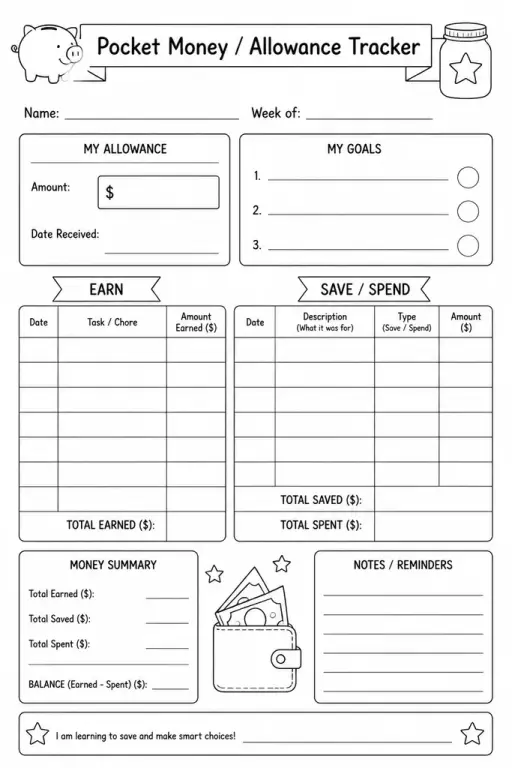
Pocket Money / Allowance Tracker
Parent & Home Printables
Ages 4–11
——
KiwiBee uses optional Google Analytics, Google Ads, and Meta Pixel cookies to understand adult visitors, measure completed sign-ups, and improve campaigns. Essential cookies always stay on. OpenAI’s ChatGPT Ads Pixel also measures page views and completed enquiries after advertising consent, and may use hashed contact details for matching. Privacy policy

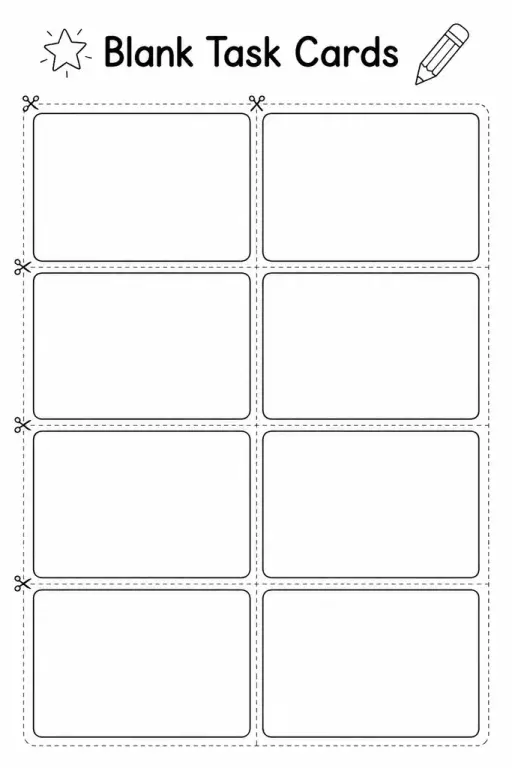
This printable set of blank visual timetable cards gives teachers a flexible, reusable tool for displaying the daily or weekly schedule in a way all learners can follow. Each card features a large central picture box and a label line beneath it, so teachers can draw, stamp, or glue a subject icon and write the lesson name or time. Cards slot into a pocket chart, attach to a Velcro strip, or hang from a rail to form a left-to-right or top-to-bottom sequence across the classroom wall. Visual timetables are especially powerful for students with autism spectrum conditions, language processing differences, or anxiety around transitions, but they benefit every learner by reducing uncertainty about what comes next. The blank format means this set works for any school timetable structure, any language, and any year level.
Standard cards at roughly 9 cm × 12 cm are visible from most classroom seats. For early childhood classrooms or students with visual impairments, print at A5 size for maximum clarity.
No. Velcro dots on the back of each card and a fabric strip on the wall work just as well. Magnets on a whiteboard rail are another low-cost option, and bulldog clips on a string work for smaller rooms.
Keep a small set of blank unlined cards alongside your timetable display. If a lesson changes, quickly sketch or write the new activity on a blank card and slot it in — the flexibility is the key advantage of physical cards over a digital display.
Absolutely. Arrange five columns (one per school day) and add subject cards down each column. A weekly visual is particularly useful for students who need to know several days ahead to manage transitions well.
See what other teachers think and share a helpful note.
Generate a fresh worksheet for any grade, topic and language. Free.
 Home
Home All solutions
 Pricing
 About us
 KiwiBee for Non-profits
 Events & webinars
 For big organisations
 For schools
 For centers
 For team leaders
 For teachers
 AI and resources
 Resources
 Printable worksheets
 Lesson Packs
 Interactive simulations
 Teacher tools
 AI studio
 Ideas and research