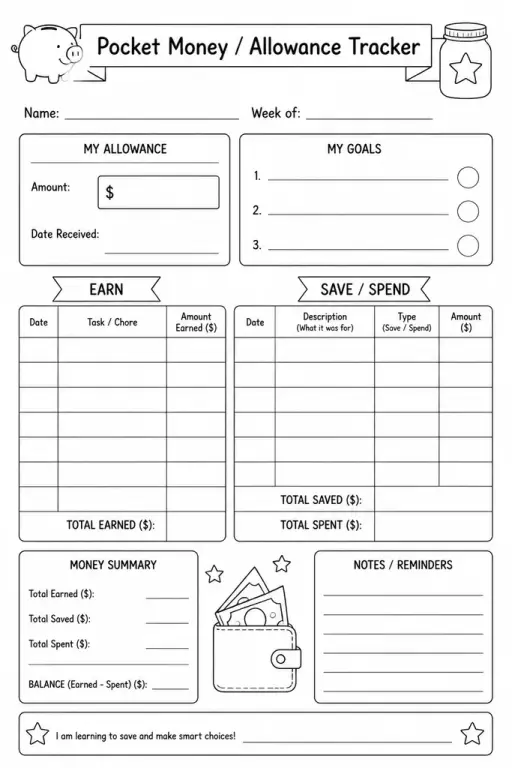
Pocket Money / Allowance Tracker
Parent & Home Printables
Ages 4–11
——
KiwiBee uses optional Google Analytics, Google Ads, and Meta Pixel cookies to understand adult visitors, measure completed sign-ups, and improve campaigns. Essential cookies always stay on. OpenAI’s ChatGPT Ads Pixel also measures page views and completed enquiries after advertising consent, and may use hashed contact details for matching. Privacy policy

The Differentiated Lesson Plan template provides a three-tier blank frame that prompts teachers to plan the same lesson concept at three levels of support: scaffolded support for students working below grade-level expectations, on-level instruction for the core group, and extension or enrichment for students ready to go deeper. All three tiers share the same learning objective box at the top, reinforcing that differentiation is about varying access and complexity, not lowering or abandoning the standard. Inclusive classroom teachers, special-education co-teachers, and literacy or numeracy intervention specialists find this template invaluable during unit-planning sessions. It makes the intentional design of tiered tasks, resources, and assessment evidence visible in a single document, which is especially useful during moderation meetings or when justifying instructional decisions to parents and school leaders.
In this template, Tier 1 refers to the highest level of instructional support, not the lowest ability. Every student can benefit from scaffolding at times, and placement may shift lesson to lesson depending on the topic.
Yes. The blank three-tier layout works for science, humanities, languages, arts, and PE — any lesson where students need varied entry points to access the same concept.
Use the success criteria or evidence column within each tier to note what acceptable demonstration of the objective looks like at each level of complexity. The standard remains constant; the evidence form varies.
The three-tier language directly mirrors RTI's universal, targeted, and intensive support model, making this template a natural planning tool within RTI or Multi-Tiered System of Supports (MTSS) programmes.
See what other teachers think and share a helpful note.
Generate a fresh worksheet for any grade, topic and language. Free.
 Home
Home All solutions
 Pricing
 About us
 KiwiBee for Non-profits
 Events & webinars
 For big organisations
 For schools
 For centers
 For team leaders
 For teachers
 AI and resources
 Resources
 Printable worksheets
 Lesson Packs
 Interactive simulations
 Teacher tools
 AI studio
 Ideas and research