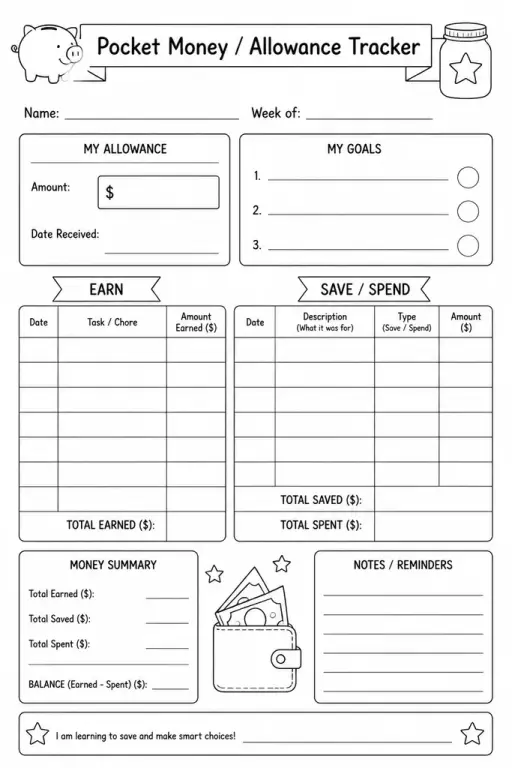
Pocket Money / Allowance Tracker
Parent & Home Printables
Ages 4–11
——
KiwiBee uses optional Google Analytics, Google Ads, and Meta Pixel cookies to understand adult visitors, measure completed sign-ups, and improve campaigns. Essential cookies always stay on. OpenAI’s ChatGPT Ads Pixel also measures page views and completed enquiries after advertising consent, and may use hashed contact details for matching. Privacy policy

The Single-Point Rubric is a one-column standard template that lists only the proficient level of performance for each criterion, leaving open space on either side for written feedback about where a student fell short or exceeded that standard. Instead of pre-writing descriptors for every possible performance level, you focus energy on defining what 'meeting the standard' looks like — and respond to each student's actual work in the feedback columns. Teachers across all grade levels find this format faster to design and more conversational to use than multi-level rubrics. Students tend to read single-point rubrics more carefully because the feedback is personal rather than a pre-printed band. It is especially popular for project-based learning, writing workshops, and portfolio assessment where nuanced commentary matters more than a numerical score.
Leave those columns blank or write a brief affirmation. The power of the format is that you only annotate where there is a meaningful gap or a notable strength worth naming.
Many teachers use single-point rubrics for formative tasks and then attach a holistic or analytic score for reporting. The rubric itself does not prevent you from adding a grade — it just prioritises feedback over levels.
Three to five criteria fits comfortably on one page and keeps feedback focused. More than six criteria can make the sheet unwieldy and the feedback generic.
Yes — it is an excellent peer-feedback tool. Assign partners to read each other's work and write specific comments in the feedback columns using the proficiency statement as the anchor.
See what other teachers think and share a helpful note.
Generate a fresh worksheet for any grade, topic and language. Free.
 Home
Home All solutions
 Pricing
 About us
 KiwiBee for Non-profits
 Events & webinars
 For big organisations
 For schools
 For centers
 For team leaders
 For teachers
 AI and resources
 Resources
 Printable worksheets
 Lesson Packs
 Interactive simulations
 Teacher tools
 AI studio
 Ideas and research