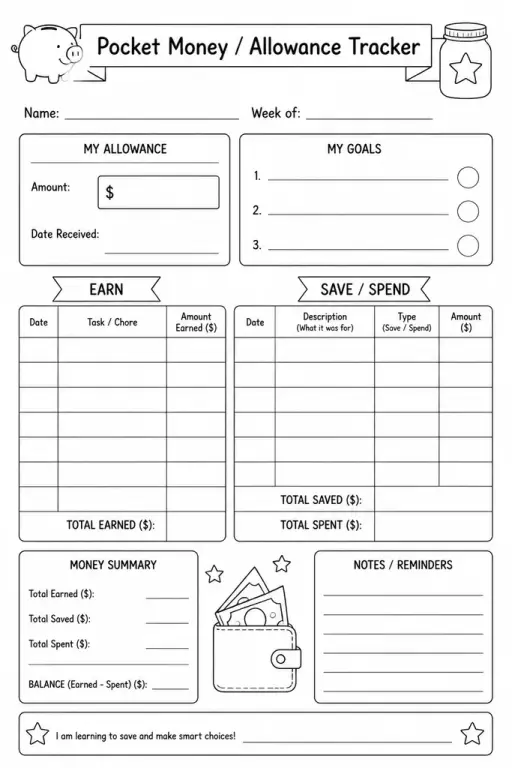
Pocket Money / Allowance Tracker
Parent & Home Printables
Ages 4–11
——
KiwiBee uses optional Google Analytics, Google Ads, and Meta Pixel cookies to understand adult visitors, measure completed sign-ups, and improve campaigns. Essential cookies always stay on. OpenAI’s ChatGPT Ads Pixel also measures page views and completed enquiries after advertising consent, and may use hashed contact details for matching. Privacy policy

A Single Lesson Plan template structures one self-contained class period around four core phases: a clear learning objective at the top, a starter activity to activate prior knowledge, a main activity section where new content is taught and practised, and a plenary that brings the lesson to a reflective close. Teachers fill in each section from scratch, which keeps planning flexible and subject-agnostic — the same format works equally well for a 30-minute primary maths session or a 60-minute secondary English lesson. The framing forces purposeful design: you cannot fill in a plenary without knowing what the objective was, and you cannot design a strong starter without thinking about prior knowledge. New and experienced teachers both benefit — new teachers use it as a scaffold for lesson structure, while experienced teachers appreciate the speed with which a coherent plan takes shape inside a familiar four-box frame.
The starter is typically a short 5–10 minute activity that recalls prior learning, sparks curiosity, or sets context for the new content — a quick quiz, a provocative image, a warm-up problem, or a vocabulary recap all work well here.
Yes. The four sections are phase-based, not time-fixed. For a double period, you might split the main activity into two sub-phases — introduce new content, then move to independent or collaborative practice — and expand the timing accordingly.
Specific and observable. Avoid broad aims like 'understand fractions'. Prefer statements like 'add two fractions with different denominators using equivalent fractions' — something you can actually check at the end of the lesson.
Yes. Simply relabel the starter/main/plenary boxes with your platform's equivalent phases (e.g. synchronous warm-up, breakout task, whole-group debrief) and add a row for tech/link notes.
See what other teachers think and share a helpful note.
Generate a fresh worksheet for any grade, topic and language. Free.
 Home
Home All solutions
 Pricing
 About us
 KiwiBee for Non-profits
 Events & webinars
 For big organisations
 For schools
 For centers
 For team leaders
 For teachers
 AI and resources
 Resources
 Printable worksheets
 Lesson Packs
 Interactive simulations
 Teacher tools
 AI studio
 Ideas and research