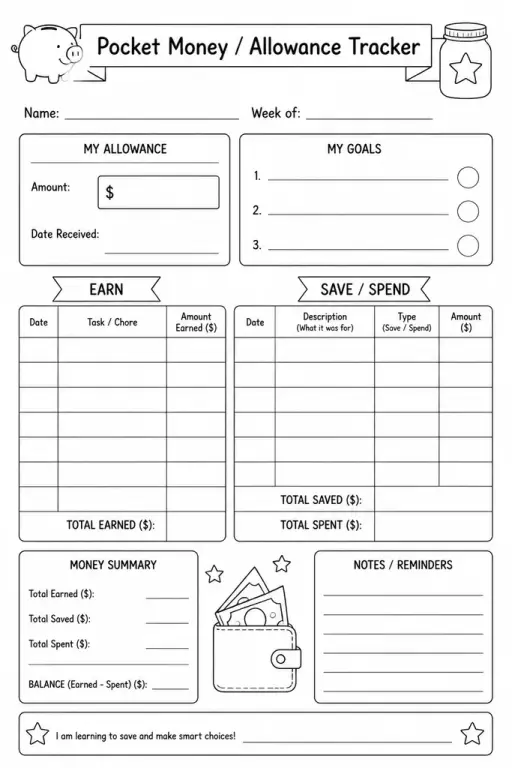
Pocket Money / Allowance Tracker
Parent & Home Printables
Ages 4–11
——
KiwiBee uses optional Google Analytics, Google Ads, and Meta Pixel cookies to understand adult visitors, measure completed sign-ups, and improve campaigns. Essential cookies always stay on. OpenAI’s ChatGPT Ads Pixel also measures page views and completed enquiries after advertising consent, and may use hashed contact details for matching. Privacy policy

The Seating Chart Template is a blank desk-grid plan that teachers draw, print, and fill in to map every seat in their classroom. The empty grid provides a visual overview of the room layout — rows, clusters, horseshoe, or pairs — which the teacher then populates with student names, numbers, or codes. A completed chart becomes an indispensable reference for marking the register, directing discussion, conducting random cold-calling, and handing out resources efficiently. Because the template is entirely blank, it adapts to any room configuration: a compact primary classroom with 30 desks in rows, a science lab with fixed benches, a small intervention room with six chairs, or a large lecture hall. Teachers reprint it whenever the arrangement changes. Supply and cover teachers use a completed copy to manage an unfamiliar class with confidence from the first moment. It is also a practical tool for parents' evenings when explaining group dynamics or for SLT walkthrough observations.
Yes. The grid is blank so you draw in the desk shapes that match your actual arrangement. Rows use individual small rectangles, clusters use grouped larger squares, and a horseshoe is drawn as a U-shape around the perimeter of the grid.
Update it every time you make a seating change — even a small swap. An out-of-date chart creates confusion for cover staff and reduces its usefulness as a classroom management tool. Print a fresh copy; it takes under two minutes.
Absolutely. The blank grid is flexible enough to map fixed laboratory benches, computer-room rows, or any fixed-furniture space. Simply draw the fixed shapes onto the grid and label them accordingly.
Yes — a completed digital version (PDF or image) shared via your school's staff platform works well. Some teachers photograph their whiteboard seating plan or use the editable PDF and email it to the cover supervisor at the start of each day.
See what other teachers think and share a helpful note.
Generate a fresh worksheet for any grade, topic and language. Free.
 Home
Home All solutions
 Pricing
 About us
 KiwiBee for Non-profits
 Events & webinars
 For big organisations
 For schools
 For centers
 For team leaders
 For teachers
 AI and resources
 Resources
 Printable worksheets
 Lesson Packs
 Interactive simulations
 Teacher tools
 AI studio
 Ideas and research