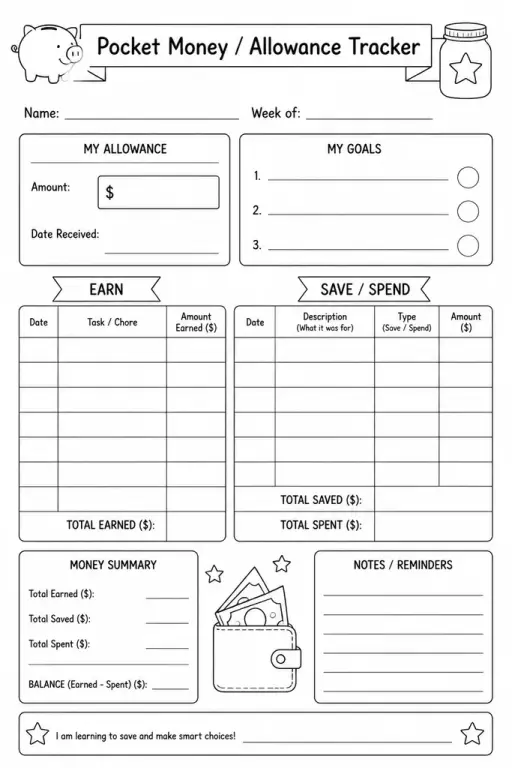
Pocket Money / Allowance Tracker
Parent & Home Printables
Ages 4–11
——
KiwiBee uses optional Google Analytics, Google Ads, and Meta Pixel cookies to understand adult visitors, measure completed sign-ups, and improve campaigns. Essential cookies always stay on. OpenAI’s ChatGPT Ads Pixel also measures page views and completed enquiries after advertising consent, and may use hashed contact details for matching. Privacy policy

The Score Recording Sheet is a focused, blank marks-entry grid built for the moment immediately after an assessment — when you need to write down results quickly before papers get shuffled. Unlike a full gradebook, each sheet is designed around a single assessment event: one row per student, one column per question or criterion, and a total column at the right edge. Teachers use this template during oral quizzes, rapid written tests, lab practicals, or any task where you are scoring in real time or entering marks straight off a pile of papers. It works equally well for tracking competition scores, reading-fluency timing, or sports-day results. Print a fresh sheet for each event and file it as a source document.
The gradebook is designed for tracking scores across many assessments over a whole term. The score recording sheet is purpose-built for one assessment — it emphasises per-item breakdown rather than cross-assessment history.
Yes — the cells are blank so you can write any notation your marking scheme uses: whole numbers, decimals, fractions, letter grades, or even ticks and crosses.
Print two sheets and staple them together, continuing the column labels across both. Alternatively, group related questions and enter a sub-total in one column (e.g. 'Q1–5 total').
For official standardised assessments, check whether your school or exam board requires specific recording forms. This template is ideal for teacher-made assessments and formative checks where you design your own grid.
See what other teachers think and share a helpful note.
Generate a fresh worksheet for any grade, topic and language. Free.
 Home
Home All solutions
 Pricing
 About us
 KiwiBee for Non-profits
 Events & webinars
 For big organisations
 For schools
 For centers
 For team leaders
 For teachers
 AI and resources
 Resources
 Printable worksheets
 Lesson Packs
 Interactive simulations
 Teacher tools
 AI studio
 Ideas and research