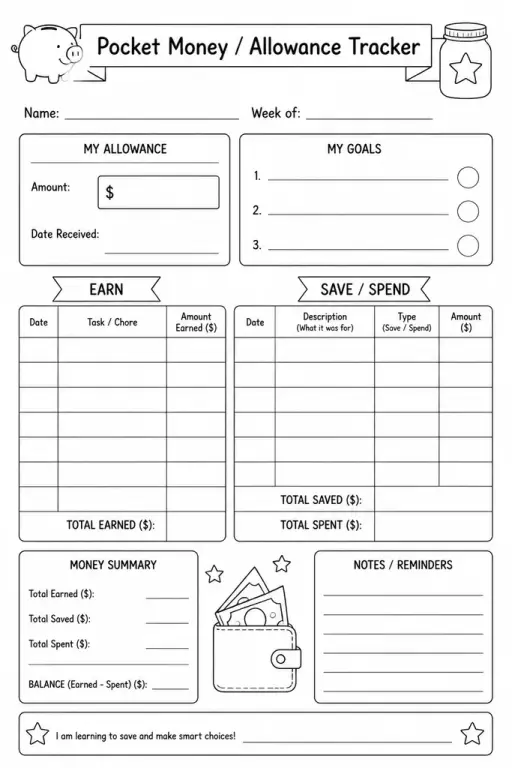
Pocket Money / Allowance Tracker
Parent & Home Printables
Ages 4–11
——
KiwiBee uses optional Google Analytics, Google Ads, and Meta Pixel cookies to understand adult visitors, measure completed sign-ups, and improve campaigns. Essential cookies always stay on. OpenAI’s ChatGPT Ads Pixel also measures page views and completed enquiries after advertising consent, and may use hashed contact details for matching. Privacy policy

A Scheme of Work Template is a structured grid that links learning objectives to teaching activities, resources, and assessment opportunities across a defined teaching sequence. Unlike a lesson plan, which focuses on a single session, and unlike a yearly overview, which stays deliberately high-level, a scheme of work sits at the curriculum design layer — it is the document that translates curriculum standards into a teachable, sequenced programme for a class or year group. Department heads and curriculum leads use blank copies of this template during curriculum review weeks; individual teachers use it when building a new course from the ground up. Because every column in the grid is left blank, the template imposes structure — objectives, activities, resources, and assessment all have designated spaces — without prescribing any specific content. It is suitable for any subject, any year group, and any national curriculum framework.
At minimum: lesson or week number, learning objective, main content or concept, teaching activity, resources needed, and assessment method. Additional columns for differentiation, cross-curricular links, or curriculum codes are optional but common.
It depends on the course. A half-term unit might produce 6–10 rows; a full year's scheme for a secondary subject might run to 36 rows or more. The template can be extended by printing additional pages or copying the grid.
They overlap, but a scheme of work typically carries more curriculum design intent — it references standards, assessment criteria, and the rationale for sequencing. A medium-term plan is often more operational, focused on the specific lessons within a half-term.
Schools and trusts vary. Many require a scheme for every subject from the lead teacher or department head. Individual classroom teachers usually work from an existing shared scheme rather than writing their own from scratch each year.
See what other teachers think and share a helpful note.
Generate a fresh worksheet for any grade, topic and language. Free.
 Home
Home All solutions
 Pricing
 About us
 KiwiBee for Non-profits
 Events & webinars
 For big organisations
 For schools
 For centers
 For team leaders
 For teachers
 AI and resources
 Resources
 Printable worksheets
 Lesson Packs
 Interactive simulations
 Teacher tools
 AI studio
 Ideas and research