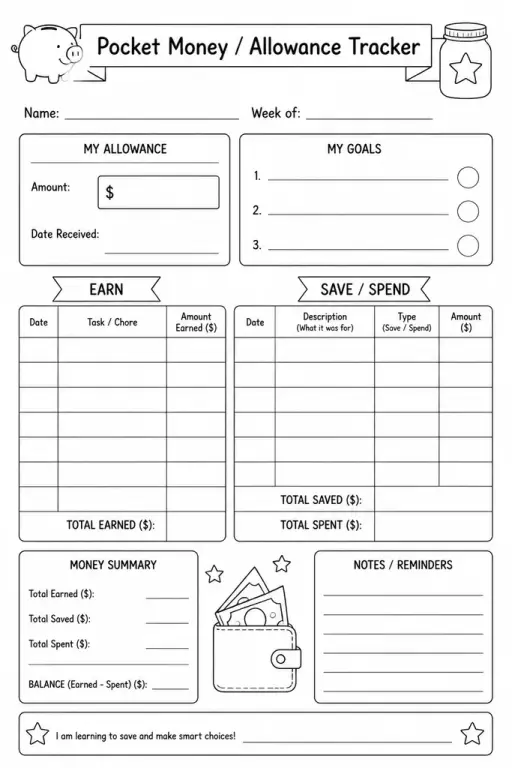
Pocket Money / Allowance Tracker
Parent & Home Printables
Ages 4–11
——
KiwiBee uses optional Google Analytics, Google Ads, and Meta Pixel cookies to understand adult visitors, measure completed sign-ups, and improve campaigns. Essential cookies always stay on. OpenAI’s ChatGPT Ads Pixel also measures page views and completed enquiries after advertising consent, and may use hashed contact details for matching. Privacy policy

The 4-Level Rubric Template is a blank criteria-by-level grid that teachers fill in to build consistent, transparent scoring guides for any task or project. The horizontal axis provides four performance levels — typically Beginning, Developing, Proficient, and Extending, though you can relabel them — while the vertical axis lists each assessment criterion. Every cell is left blank for you to write the specific descriptors that fit your task. This template suits teachers at any grade level creating rubrics for writing assignments, oral presentations, science investigations, art projects, or collaborative tasks. Students also benefit when the rubric is shared before work begins, as the four clearly defined levels help them self-assess and set targets. Download once, reuse across every subject.
Three to six criteria is the most practical range for a single rubric. Too few criteria and the scoring is shallow; too many and both marking and student self-assessment become overwhelming.
Yes — add a 'Weight' column next to the criteria column and note the percentage or point multiplier for each row. The blank grid leaves all such decisions to you.
Four levels avoid the 'safe middle' choice that a 3-point scale produces and are less granular than a 5-point scale, making descriptor writing and scoring faster. Many curriculum frameworks also use a four-level progression, which makes alignment easier.
Absolutely — that is its purpose. Print as many copies as you need and write new criteria and descriptors each time. The grid itself remains identical across all your subjects.
See what other teachers think and share a helpful note.
Generate a fresh worksheet for any grade, topic and language. Free.
 Home
Home All solutions
 Pricing
 About us
 KiwiBee for Non-profits
 Events & webinars
 For big organisations
 For schools
 For centers
 For team leaders
 For teachers
 AI and resources
 Resources
 Printable worksheets
 Lesson Packs
 Interactive simulations
 Teacher tools
 AI studio
 Ideas and research