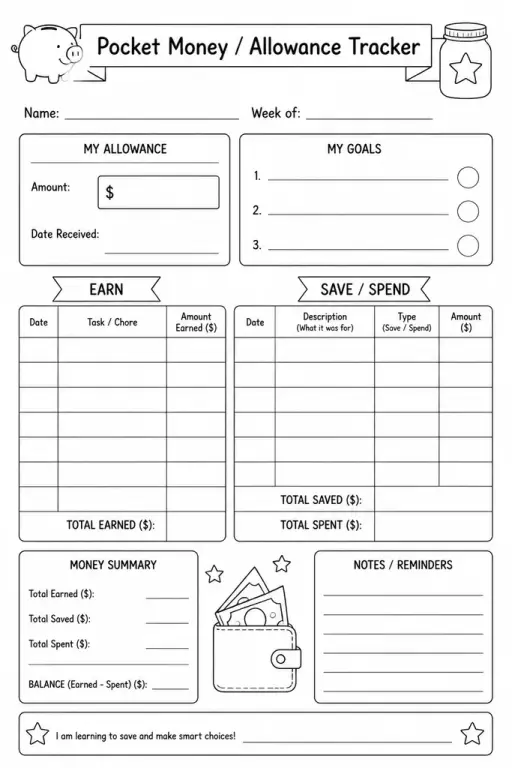
Pocket Money / Allowance Tracker
Parent & Home Printables
Ages 4–11
——
KiwiBee uses optional Google Analytics, Google Ads, and Meta Pixel cookies to understand adult visitors, measure completed sign-ups, and improve campaigns. Essential cookies always stay on. OpenAI’s ChatGPT Ads Pixel also measures page views and completed enquiries after advertising consent, and may use hashed contact details for matching. Privacy policy

The Reward and Behaviour Chart for Home is a blank star-reward grid that parents customise to recognise and encourage positive behaviour at home. The template provides rows for behaviours or goals — such as staying calm during transitions, completing homework without reminders, or using kind words — and columns for each day of the week. Each time a child meets a behaviour, parents award a star, sticker, or checkmark in the corresponding cell. Designed for PreK through Grade 6, this chart works best when goals are specific, visible, and celebrated regularly. Parents set the number of stars needed to earn a chosen reward, making the system transparent and motivating. The blank format means the chart adapts to any behaviour currently needing focus — from bedtime compliance in a four-year-old to screen-time responsibility in a ten-year-old.
Two to three specific goals is ideal. More than four risks overwhelming the child and diluting focus. Start with the behaviour causing the most daily friction and add others once the first is solid.
Experiences tend to work better than objects — a movie night, choosing dinner, extra story time, or a trip to the park. Agree the reward before the week starts so it feels like a genuine contract.
Sticking to the agreed threshold preserves the chart's credibility. You can acknowledge the partial success warmly and reset with a slightly lower star target next week to set your child up for a win.
Most children respond well up to around age 10–11. Beyond that, a conversation-based approach or goal-tracking journal often works better. The chart can still be useful for specific short-term goals with older children.
See what other teachers think and share a helpful note.
Generate a fresh worksheet for any grade, topic and language. Free.
 Home
Home All solutions
 Pricing
 About us
 KiwiBee for Non-profits
 Events & webinars
 For big organisations
 For schools
 For centers
 For team leaders
 For teachers
 AI and resources
 Resources
 Printable worksheets
 Lesson Packs
 Interactive simulations
 Teacher tools
 AI studio
 Ideas and research