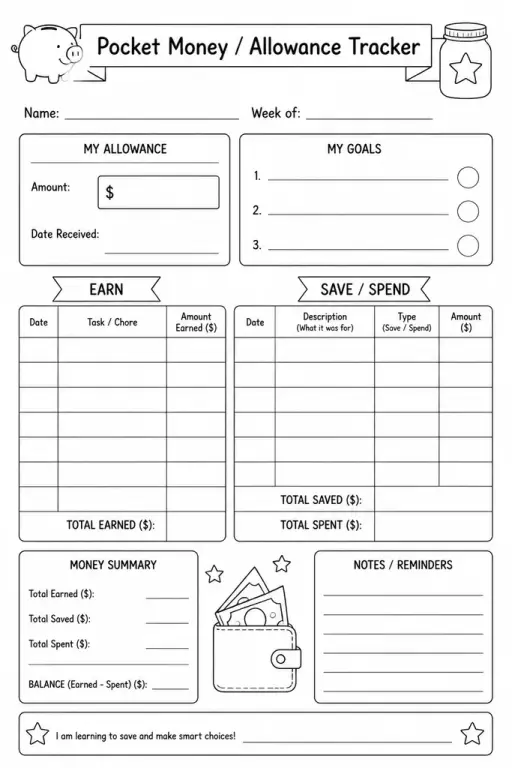
Pocket Money / Allowance Tracker
Parent & Home Printables
Ages 4–11
——
KiwiBee uses optional Google Analytics, Google Ads, and Meta Pixel cookies to understand adult visitors, measure completed sign-ups, and improve campaigns. Essential cookies always stay on. OpenAI’s ChatGPT Ads Pixel also measures page views and completed enquiries after advertising consent, and may use hashed contact details for matching. Privacy policy

This blank Jeopardy-style review board gives teachers a fully editable category-and-points grid to build quiz-show review sessions for any subject. The template lays out five category columns and five point-value rows (e.g. 100 through 500), with each cell blank so the teacher writes in questions or clues that fit exactly what students have been studying. No subscription, no digital licence — just print, fill, and run. Teachers write category titles across the top and questions behind each value card. During play, teams choose a category and point value, the teacher reads the clue, and teams answer. The format naturally differentiates: lower-point cells hold simpler recall questions while higher-point cells push for analysis or application. Laminate the grid and cover cells with sticky notes for a reusable game board that works year after year.
Five categories with 100–500 point tiers is the classic setup. For shorter sessions or younger students, reduce to four categories and three tiers (100, 200, 300) to keep the game under 20 minutes.
Print the grid large, laminate it, and use sticky notes as covers. Stick it on the board with magnets. When a cell is chosen, peel the note and read the question from your answer key.
Yes, and it deepens learning. Split the class into groups, assign each a category, and have them write questions for every point level. Teacher reviews before game day.
Use a simple 'hand-up first' rule or a soft chime for buzzers. Assign a neutral student judge to call the first responder each round.
See what other teachers think and share a helpful note.
Generate a fresh worksheet for any grade, topic and language. Free.
 Home
Home All solutions
 Pricing
 About us
 KiwiBee for Non-profits
 Events & webinars
 For big organisations
 For schools
 For centers
 For team leaders
 For teachers
 AI and resources
 Resources
 Printable worksheets
 Lesson Packs
 Interactive simulations
 Teacher tools
 AI studio
 Ideas and research