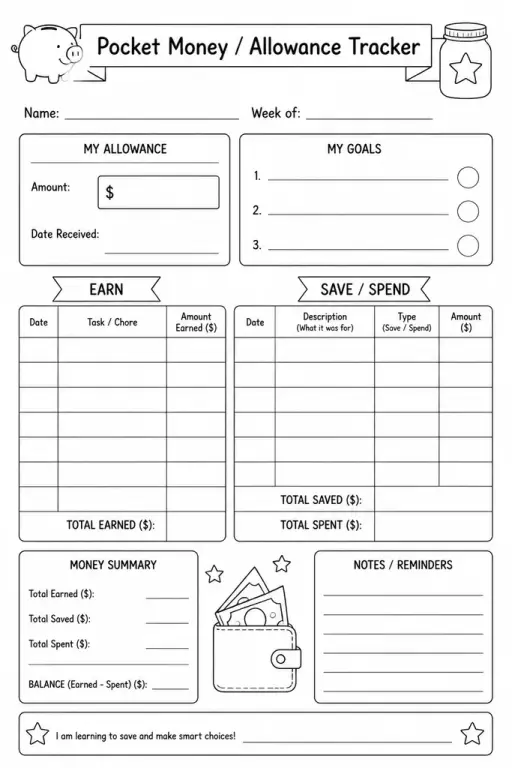
Pocket Money / Allowance Tracker
Parent & Home Printables
Ages 4–11
——
KiwiBee uses optional Google Analytics, Google Ads, and Meta Pixel cookies to understand adult visitors, measure completed sign-ups, and improve campaigns. Essential cookies always stay on. OpenAI’s ChatGPT Ads Pixel also measures page views and completed enquiries after advertising consent, and may use hashed contact details for matching. Privacy policy

The Reading Record / Running Record template is a blank observation sheet that lets teachers capture exactly what happens when a child reads aloud. The page provides a lined text area where the teacher transcribes or annotates the reading passage, alongside a notation column for marking substitutions, omissions, insertions, repetitions, and self-corrections using standard running-record symbols. A dedicated accuracy and self-correction ratio section sits at the foot of the sheet, leaving space to calculate reading level and jot quick qualitative notes on fluency, phrasing, and comprehension. Completely free of pre-filled text, the template works with any decodable reader, levelled book, or classroom novel — from Foundation Stage through to upper primary — making it an everyday tool for guided reading rotations and reading recovery sessions.
Standard running-record notation (tick, SC, E, O, R, T) is widely used in primary schools and takes only a short time to learn. A brief key card is easy to print and clip to your clipboard alongside the template.
You can use it with any text. For a formal accuracy calculation you need to know the total word count, but for qualitative observation during guided reading any book works well.
For a 100–200 word passage, most experienced teachers complete a running record in three to five minutes. The blank template is sized for up to around 200 words.
Yes. The notation column can capture language-transfer patterns as well as decoding errors, and the qualitative notes section gives space to record observations about comprehension and expression specific to EAL learners.
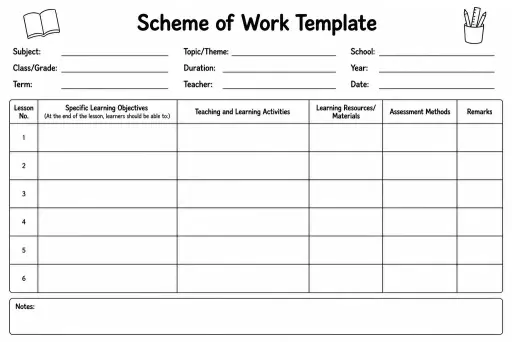
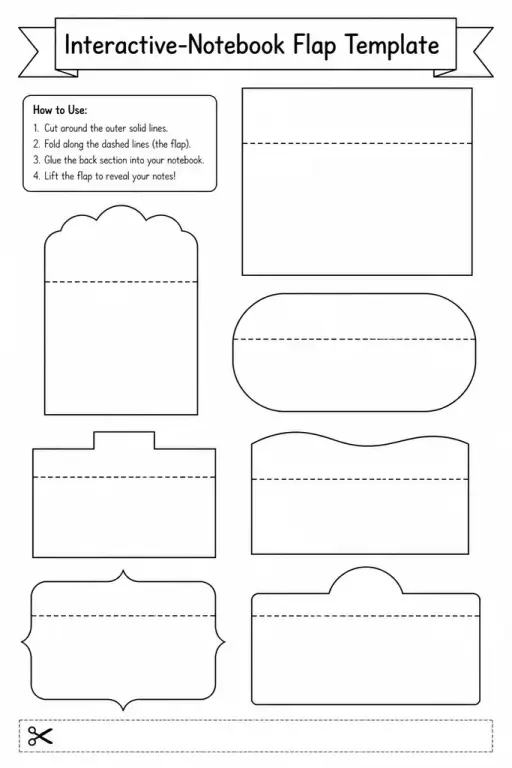
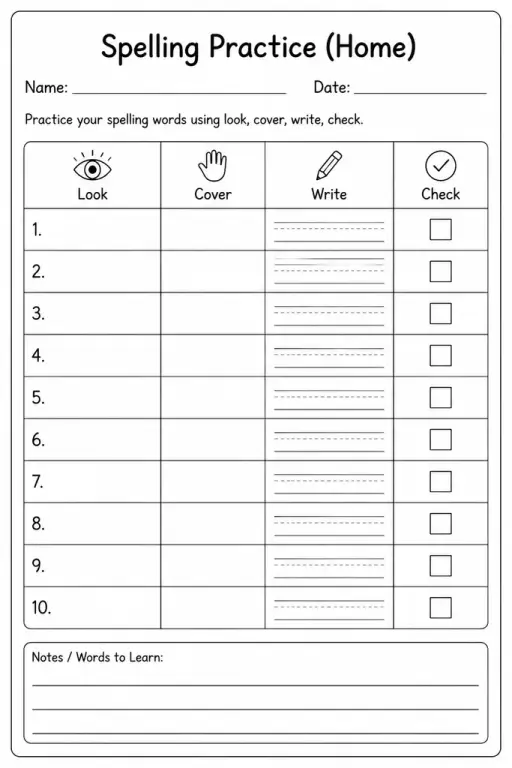
See what other teachers think and share a helpful note.
Generate a fresh worksheet for any grade, topic and language. Free.
 Home
Home All solutions
 Pricing
 About us
 KiwiBee for Non-profits
 Events & webinars
 For big organisations
 For schools
 For centers
 For team leaders
 For teachers
 AI and resources
 Resources
 Printable worksheets
 Lesson Packs
 Interactive simulations
 Teacher tools
 AI studio
 Ideas and research