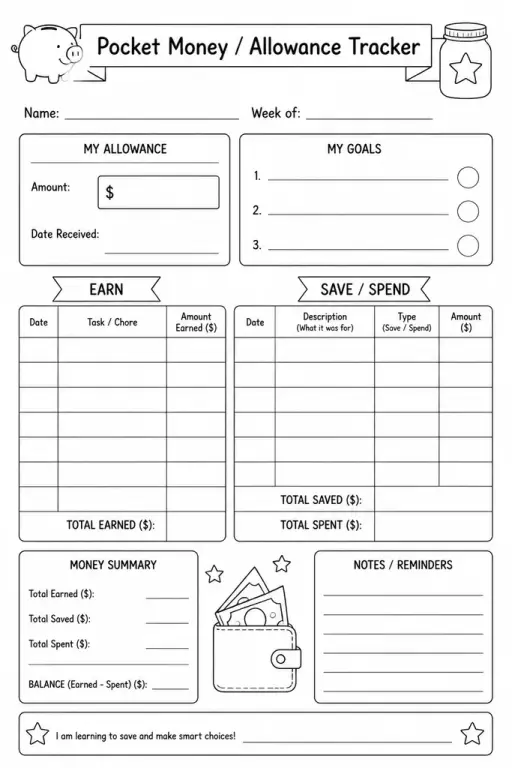
Pocket Money / Allowance Tracker
Parent & Home Printables
Ages 4–11
——
KiwiBee uses optional Google Analytics, Google Ads, and Meta Pixel cookies to understand adult visitors, measure completed sign-ups, and improve campaigns. Essential cookies always stay on. OpenAI’s ChatGPT Ads Pixel also measures page views and completed enquiries after advertising consent, and may use hashed contact details for matching. Privacy policy

The Pupil Profile Template is a single-page, blank learner overview that captures the most important information about one student in one place. Teachers fill in the page at the start of a school year or when a new student joins the class, recording details such as learning style, key strengths, areas of difficulty, medical or pastoral notes, target grades, and any SEND or EAL considerations. The result is a one-stop reference that replaces the need to hunt through multiple systems whenever a cover teacher, form tutor, or specialist needs quick context about a child. The blank format lets each teacher, school, or department choose which fields matter most for their setting. Primary teachers use it as a pastoral overview for a whole class; secondary subject teachers use it as a brief subject-specific snapshot; learning-support staff use it alongside individual education plans. Kept in a class folder or shared digitally, the profile ensures every adult working with the student starts from the same informed baseline.
The blank template itself contains no personal data. How you store completed profiles is governed by your school's data-protection policy. Keep filled profiles in a secure, password-protected location and limit access to staff with a legitimate need.
A pupil profile is a brief, at-a-glance overview of a whole learner — academic, social, medical, and pastoral. An IEP is a formal, detailed document focused specifically on SEND targets and provision. Profiles complement IEPs but are shorter and cover all students, not only those on the SEND register.
Each profile must be completed individually because the content is student-specific. However, printing a stack of blank templates and completing them during a planning session — or asking students to complete a self-version — speeds the process considerably.
Sharing a profile with older students can be a powerful reflective tool, especially if you invite them to verify or add to it. For younger students, a simplified version focusing on strengths and goals is appropriate. Always use professional judgement about which details to share.
See what other teachers think and share a helpful note.
Generate a fresh worksheet for any grade, topic and language. Free.
 Home
Home All solutions
 Pricing
 About us
 KiwiBee for Non-profits
 Events & webinars
 For big organisations
 For schools
 For centers
 For team leaders
 For teachers
 AI and resources
 Resources
 Printable worksheets
 Lesson Packs
 Interactive simulations
 Teacher tools
 AI studio
 Ideas and research