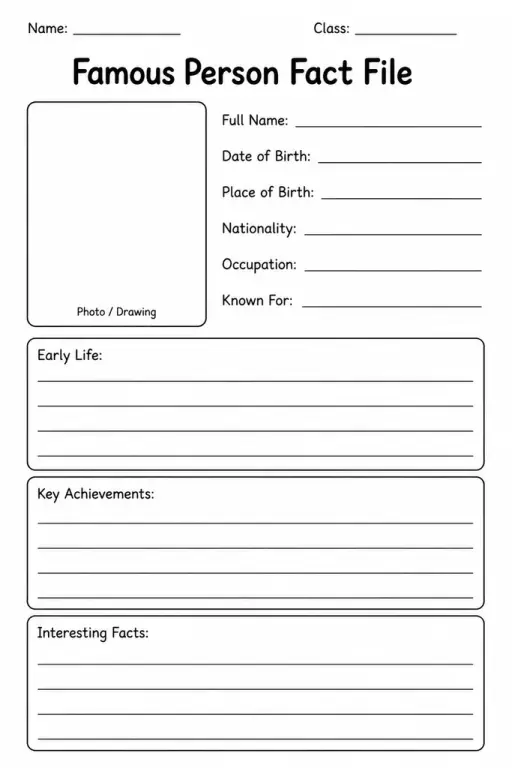
Famous Person Fact File
Social Studies Templates
Ages 4–11
——
KiwiBee uses optional Google Analytics, Google Ads, and Meta Pixel cookies to understand adult visitors, measure completed sign-ups, and improve campaigns. Essential cookies always stay on. OpenAI’s ChatGPT Ads Pixel also measures page views and completed enquiries after advertising consent, and may use hashed contact details for matching. Privacy policy

The Primary-Source Analysis Template is a structured one-page frame built around three thinking moves: Observe, Infer, and Question. Students first record what they can see or read directly in the source, then write what that evidence suggests or implies, and finally note what they still want to find out. Designed for grades 4 through 8, it is equally useful for analysing photographs, maps, letters, speeches, newspaper clippings, or artefacts. The three-part structure mirrors the disciplinary thinking habits of professional historians and aligns with inquiry-based social studies standards. Teachers can use it as a formative checkpoint during a document study, while students working independently on research projects use it to slow down and engage critically with each piece of evidence they encounter.
Any first-hand source works well: photographs, political cartoons, handwritten letters, census records, maps, advertisements, and speeches are all strong choices for grades 4 to 8.
The three-section structure specifically trains the Observe-Infer-Question habit used by historians. It prevents students from jumping straight to interpretation without grounding claims in observable evidence.
Yes, though they may need modeling for the Infer section. Starting with a vivid photograph rather than a dense text document makes the observation step accessible and the inference step more intuitive.
Yes. Science teachers use it for analysing field notebooks or historical experiment records, and ELA teachers use it with author letters or original manuscripts to study craft and context.
See what other teachers think and share a helpful note.
Generate a fresh worksheet for any grade, topic and language. Free.
 Home
Home All solutions
 Pricing
 About us
 KiwiBee for Non-profits
 Events & webinars
 For big organisations
 For schools
 For centers
 For team leaders
 For teachers
 AI and resources
 Resources
 Printable worksheets
 Lesson Packs
 Interactive simulations
 Teacher tools
 AI studio
 Ideas and research