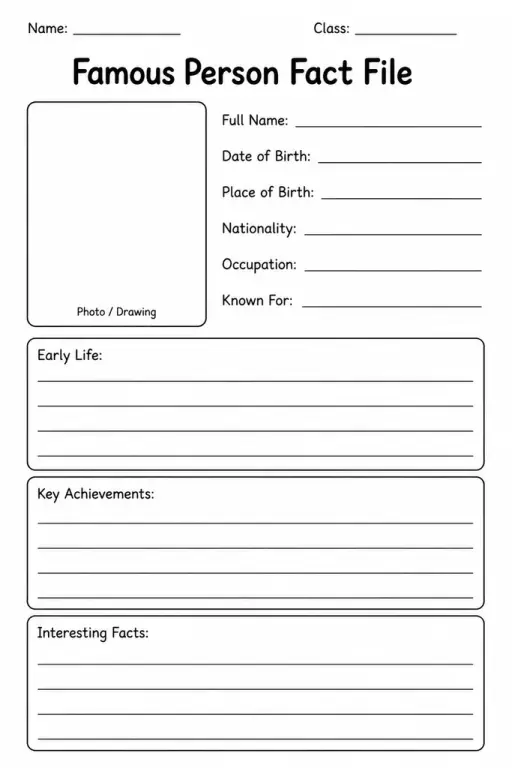
Famous Person Fact File
Social Studies Templates
Ages 4–11
——
KiwiBee uses optional Google Analytics, Google Ads, and Meta Pixel cookies to understand adult visitors, measure completed sign-ups, and improve campaigns. Essential cookies always stay on. OpenAI’s ChatGPT Ads Pixel also measures page views and completed enquiries after advertising consent, and may use hashed contact details for matching. Privacy policy

The Needs vs Wants Sort is a blank two-column sorting template that introduces young learners in kindergarten through grade 4 to one of the most fundamental concepts in economics education. The left column is headed 'Needs' and the right 'Wants', with generous empty rows where students write or draw items and then decide which category each belongs to. Teachers use it to open a unit on basic economics, community helpers, or responsible spending, while parents find it useful for kitchen-table money conversations. Because every cell is blank, the same sheet works for a drawing activity with kindergartners, a cut-and-paste sort with grade 1–2, or a written discussion task for grades 3–4. The simplicity of two columns keeps the core concept clear and avoids overwhelming early learners with complex layout.
For older students, add a third column labelled 'It Depends' to capture context-dependent items like a phone or warm coat, which pushes thinking beyond basic sorting into economic reasoning.
Yes—students can draw pictures in each column instead of writing words, making it fully accessible to non-writers and emergent writers.
Clear needs: water, a coat in winter, vegetables. Clear wants: a video game, a toy, candy. Deliberately tricky middle items like shoes ('need' in general, but branded trainers are a 'want') generate the richest discussion.
It directly supports NCSS Strand VII (Production, Distribution, Consumption) and common state economics standards for grades K–4 that address distinguishing needs from wants.
See what other teachers think and share a helpful note.
Generate a fresh worksheet for any grade, topic and language. Free.
 Home
Home All solutions
 Pricing
 About us
 KiwiBee for Non-profits
 Events & webinars
 For big organisations
 For schools
 For centers
 For team leaders
 For teachers
 AI and resources
 Resources
 Printable worksheets
 Lesson Packs
 Interactive simulations
 Teacher tools
 AI studio
 Ideas and research