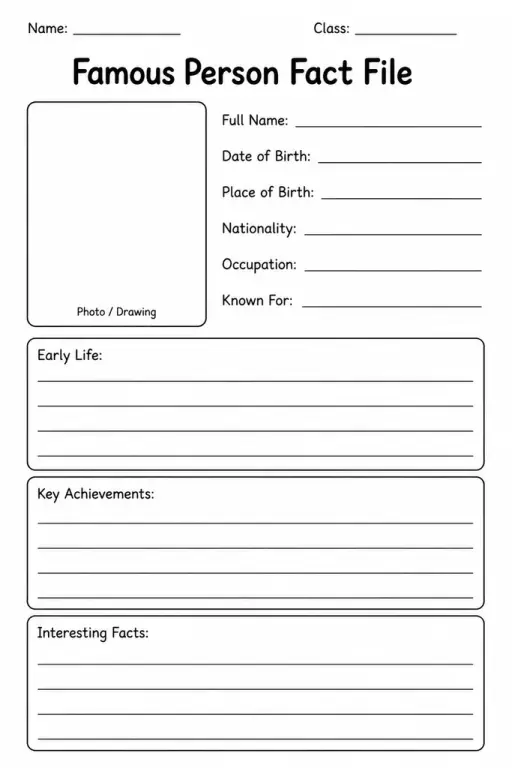
Famous Person Fact File
Social Studies Templates
Ages 4–11
——
KiwiBee uses optional Google Analytics, Google Ads, and Meta Pixel cookies to understand adult visitors, measure completed sign-ups, and improve campaigns. Essential cookies always stay on. OpenAI’s ChatGPT Ads Pixel also measures page views and completed enquiries after advertising consent, and may use hashed contact details for matching. Privacy policy

The Branches of Government (Blank) template is an empty three-column chart that students in grades 4–8 fill in to map the structure, key roles, and powers of the legislative, executive, and judicial branches. Each column has labelled rows for branch name, who belongs to it, main responsibilities, and how it checks the other two branches—but all content cells are blank, so students must supply every detail themselves. Teachers use it during civics and government units to consolidate lessons on separation of powers and checks and balances. It works equally well for the US federal government, state-level comparisons, or as a comparative frame for studying parliamentary systems in other countries. The clean, minimal layout means it prints clearly on a single A4 or letter-size page and fits neatly into an interactive notebook.
The layout is government-neutral. The three columns suit the US federal system perfectly, but teachers studying Westminster parliaments or other systems can relabel columns (e.g. Legislature, Executive, Judiciary) to match.
Yes—students simply substitute federal titles (President, Congress, Supreme Court) with their state equivalents (Governor, State Legislature, State Supreme Court).
For younger students, pre-fill the branch names and one example role per column as a model, then ask students to add two more details per branch to reduce the blank-page challenge.
Students can fold the chart so only one column is visible and self-quiz by recalling the other two, making it an effective active-recall revision tool before civics exams.
See what other teachers think and share a helpful note.
Generate a fresh worksheet for any grade, topic and language. Free.
 Home
Home All solutions
 Pricing
 About us
 KiwiBee for Non-profits
 Events & webinars
 For big organisations
 For schools
 For centers
 For team leaders
 For teachers
 AI and resources
 Resources
 Printable worksheets
 Lesson Packs
 Interactive simulations
 Teacher tools
 AI studio
 Ideas and research