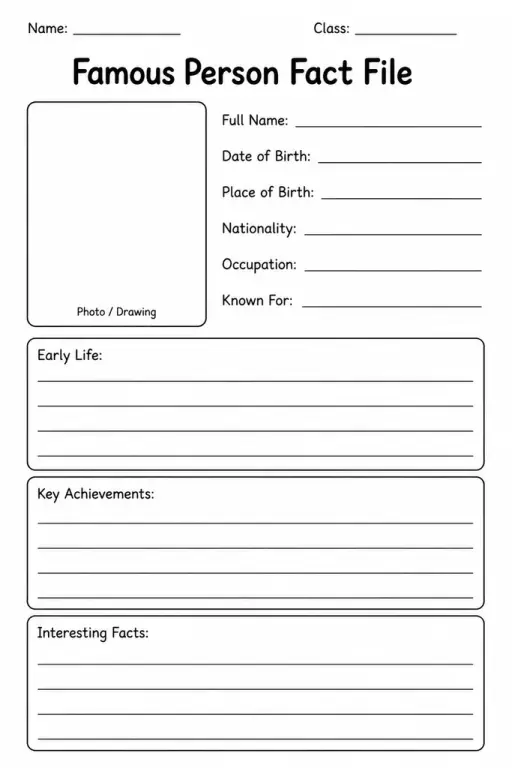
Famous Person Fact File
Social Studies Templates
Ages 4–11
——
KiwiBee uses optional Google Analytics, Google Ads, and Meta Pixel cookies to understand adult visitors, measure completed sign-ups, and improve campaigns. Essential cookies always stay on. OpenAI’s ChatGPT Ads Pixel also measures page views and completed enquiries after advertising consent, and may use hashed contact details for matching. Privacy policy

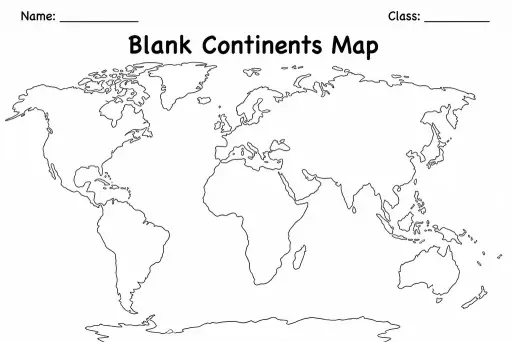
The Blank World Map is a clean outline projection of all seven continents and major oceans, printed without any country names, borders, or labels — a true blank canvas for geography activities at every level. Students in grades 2–8 use it to practise locating and naming countries, colouring climate zones, plotting trade routes, marking historical empires, or annotating physical features such as mountain ranges and rivers. Because no information is pre-filled, each print encourages active retrieval rather than passive reading. Teachers reach for it in social studies, history, and even science units — mapping biomes, migration patterns, or tectonic plates onto the same familiar outline. Parents homeschooling younger children use it as an ongoing geography game, asking students to add one new country or capital city each week until the entire map is labelled.
The standard version shows continent outlines and major coastlines only, with no internal country borders — ideal for labelling exercises where students draw in borders themselves. A lightly bordered version with visible but unlabelled country outlines is also available.
The template uses an equirectangular (plate carrée) projection, which is the most common choice for classroom outline maps because continent shapes and relative positions are easy for students to recognise from their textbooks.
Major island nations such as Japan, Indonesia, Madagascar, the Caribbean, and New Zealand are clearly included. Very small island states (e.g. Maldives, Palau) are not individually visible at this scale but their general ocean regions are marked.
Yes — it is widely used in science for mapping biomes, climate zones, tectonic plate boundaries, ocean current patterns, and the migration routes of animals or early humans, making it one of the most versatile templates in the collection.
See what other teachers think and share a helpful note.
Generate a fresh worksheet for any grade, topic and language. Free.
 Home
Home All solutions
 Pricing
 About us
 KiwiBee for Non-profits
 Events & webinars
 For big organisations
 For schools
 For centers
 For team leaders
 For teachers
 AI and resources
 Resources
 Printable worksheets
 Lesson Packs
 Interactive simulations
 Teacher tools
 AI studio
 Ideas and research