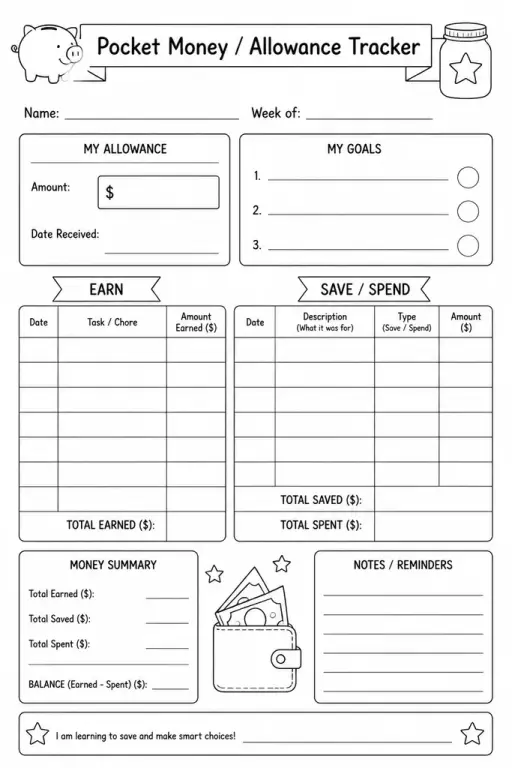
Pocket Money / Allowance Tracker
Parent & Home Printables
Ages 4–11
——
KiwiBee uses optional Google Analytics, Google Ads, and Meta Pixel cookies to understand adult visitors, measure completed sign-ups, and improve campaigns. Essential cookies always stay on. OpenAI’s ChatGPT Ads Pixel also measures page views and completed enquiries after advertising consent, and may use hashed contact details for matching. Privacy policy

The Potty-Training Chart is a blank, reusable reward-progress template that helps parents and caregivers track a toddler's bathroom attempts and successes during the potty-training journey. Rows or time slots give structure to each day while the open reward section — sticker spaces, star boxes, or checkmarks — lets families customize the system to what motivates their child. Having a physical chart on the bathroom wall turns an abstract goal into something a toddler can see and celebrate. Parents can fill in the date, mark each try or success, and choose their own reward milestones. The blank layout means it works equally well for a two-day intensive method or a gradual week-by-week approach.
Most children begin potty training between 18 months and 3 years. The chart works best once a child shows readiness signs such as staying dry for a couple of hours and showing interest in the toilet.
The blank reward area is flexible. You can draw small pictures, use rubber stamps, color in shapes, or simply make a tally mark — any mark your child finds satisfying works.
Tracking attempts (even unsuccessful ones) helps parents spot timing patterns. Many families use two different symbols — one for 'we tried' and one for 'we made it' — to keep the experience positive.
Training timelines vary widely. Some children need a week; others take a few months. Print as many copies as needed — the blank template makes reprinting simple whenever a page fills up.
See what other teachers think and share a helpful note.
Generate a fresh worksheet for any grade, topic and language. Free.
 Home
Home All solutions
 Pricing
 About us
 KiwiBee for Non-profits
 Events & webinars
 For big organisations
 For schools
 For centers
 For team leaders
 For teachers
 AI and resources
 Resources
 Printable worksheets
 Lesson Packs
 Interactive simulations
 Teacher tools
 AI studio
 Ideas and research