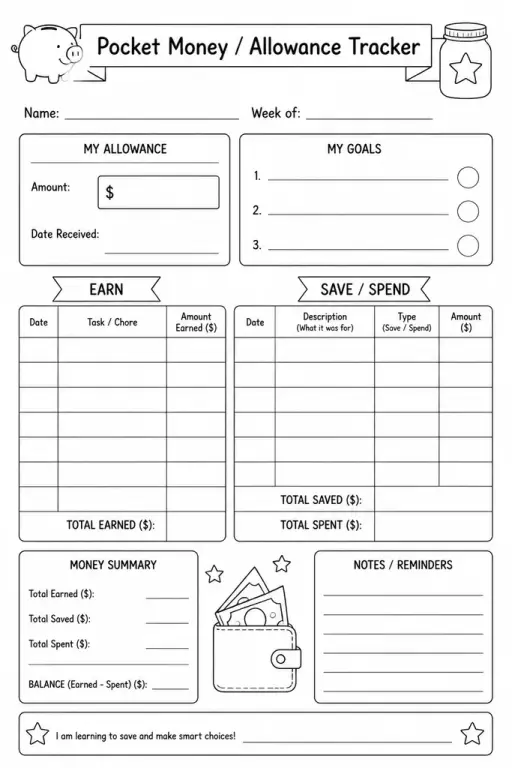
Pocket Money / Allowance Tracker
Parent & Home Printables
Ages 4–11
——
KiwiBee uses optional Google Analytics, Google Ads, and Meta Pixel cookies to understand adult visitors, measure completed sign-ups, and improve campaigns. Essential cookies always stay on. OpenAI’s ChatGPT Ads Pixel also measures page views and completed enquiries after advertising consent, and may use hashed contact details for matching. Privacy policy

A blank volume-level display that teachers customise with their own noise-level labels, colours, and icons before mounting it prominently in the classroom. Most versions use three to five levels — from silent independent work through partner voices to outdoor volume — but the blank format means any labelling system fits, including school-wide colour codes or student-designed names. A visible noise-level chart gives students an objective reference point instead of repeated verbal warnings, which research links to fewer interruptions and calmer classroom environments. Teachers use a movable clip, clothespin, or magnetic pointer to show the current expected level at a glance. The chart prints well at A3 for wall display or at A4 to slip into a plastic stand on the teacher's desk.
Three to five levels works best for most classrooms. Fewer levels (Silent / Quiet / Loud) suit younger students; older students can handle five nuanced categories tied to specific activity types.
A spring clothespin clipped to the side of a laminated chart, a magnetic arrow on a metallic whiteboard, or a simple printed arrow slipped into a pocket protector strip all work well and are easy to update mid-lesson.
Yes. Many schools adopt a shared labelling system (often colour-based) so students see consistent expectations in every room. The blank template lets each teacher match whichever school-wide system is in use.
Pair the chart with a non-verbal signal — a raised hand, two claps, or a chime — that cues students to look at the chart and self-correct. Consistency in using the signal builds the habit within a few weeks.
See what other teachers think and share a helpful note.
Generate a fresh worksheet for any grade, topic and language. Free.
 Home
Home All solutions
 Pricing
 About us
 KiwiBee for Non-profits
 Events & webinars
 For big organisations
 For schools
 For centers
 For team leaders
 For teachers
 AI and resources
 Resources
 Printable worksheets
 Lesson Packs
 Interactive simulations
 Teacher tools
 AI studio
 Ideas and research